About the Report
Base Year 2024India EV Two-Wheeler Battery Swapping Infra Market Overview
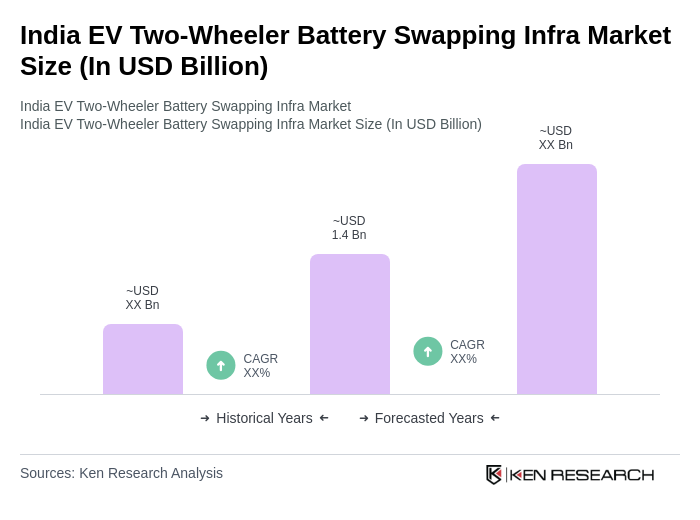
- The India EV Two-Wheeler Battery Swapping Infra Market is valued at USD 1.4 billion, based on a five-year historical analysis. This growth is driven by the rapid adoption of electric two- and three-wheelers, strong government incentives for sustainable mobility, and the urgent need for efficient charging alternatives to reduce vehicle downtime. Battery swapping is emerging as a preferred solution, particularly for commercial and fleet applications, due to its ability to provide quick turnaround and address range anxiety for users .
- Key cities such as Delhi, Bengaluru, and Mumbai continue to lead the market, supported by high population density, significant urban traffic, and proactive local government policies. These urban centers are experiencing a surge in electric two-wheeler adoption, which is accelerating the rollout of battery swapping infrastructure to support last-mile connectivity and commercial fleet operations .
- The Battery Swapping Policy, 2023, issued by the Ministry of Power, Government of India, provides a regulatory framework to promote battery swapping stations nationwide. The policy mandates interoperability standards, encourages private sector participation, and offers fiscal incentives for infrastructure development, aiming to increase accessibility and affordability of electric two-wheelers while ensuring safety and operational compliance .
India EV Two-Wheeler Battery Swapping Infra Market Segmentation
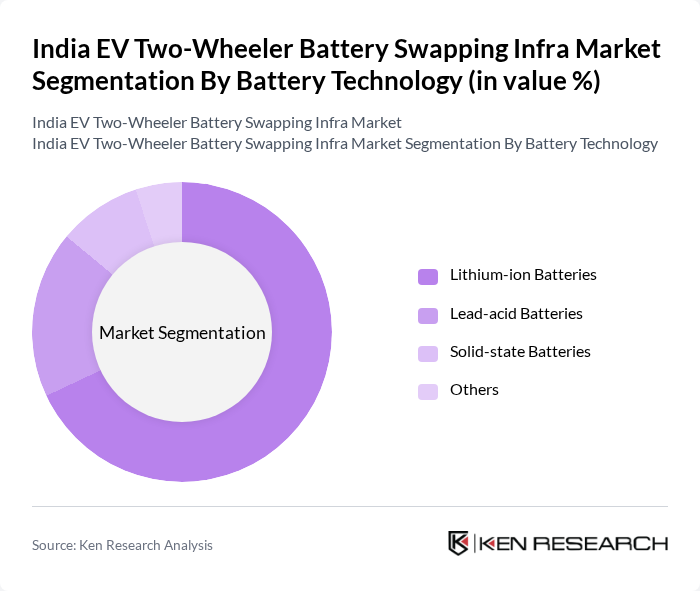
By Battery Technology:The battery technology segment is a critical determinant of efficiency and performance in battery swapping solutions. The main subsegments include Lithium-ion Batteries, Lead-acid Batteries, Solid-state Batteries, and Others. Lithium-ion Batteries maintain a dominant share due to their high energy density, long cycle life, and rapidly falling costs, making them the preferred technology for electric two-wheelers in India. Lead-acid batteries are declining in market share as fleet operators and consumers increasingly opt for lithium-ion solutions, while solid-state batteries remain in the early adoption phase .
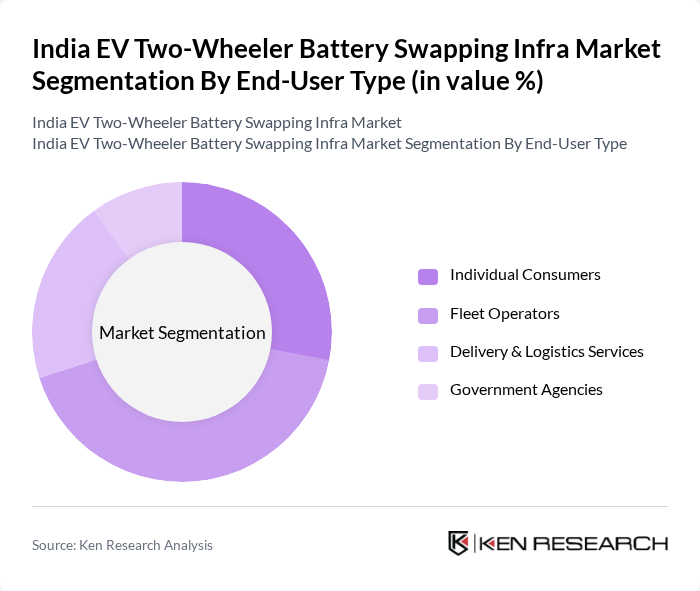
By End-User Type:The end-user segmentation includes Individual Consumers, Fleet Operators, Delivery & Logistics Services, and Government Agencies. Fleet Operators are the leading segment, propelled by the rapid growth of e-commerce, food delivery, and shared mobility services, all of which require high vehicle utilization and minimal downtime. Battery swapping offers these operators a scalable, cost-effective solution for managing large electric two-wheeler fleets .
India EV Two-Wheeler Battery Swapping Infra Market Competitive Landscape
The India EV Two-Wheeler Battery Swapping Infra Market is characterized by a dynamic mix of regional and international players. Leading participants such as Battery Smart, Lithion Power, Sun Mobility, Hero MotoCorp (Vida), Ola Electric, Bounce Infinity, Gogoro, Gravton Motors, Indian Oil Corporation, Ampere Vehicles, TVS Motor Company, Mahindra Electric, Revolt Motors, Yulu Bikes, Reliance Industries contribute to innovation, geographic expansion, and service delivery in this space.
India EV Two-Wheeler Battery Swapping Infra Market Industry Analysis
Growth Drivers
- Increasing Demand for Sustainable Transportation:The Indian government aims to achieve 30% electric vehicle penetration in future, driven by rising environmental concerns. The demand for electric two-wheelers is projected to reach 1 million units annually, reflecting a significant shift towards sustainable transportation. This transition is supported by urban populations increasingly favoring eco-friendly options, with 70% of consumers expressing interest in electric mobility solutions, according to the Ministry of Road Transport and Highways.
- Government Initiatives and Subsidies:The FAME India Scheme has allocated ?10,000 crore (approximately $1.3 billion) to promote electric vehicles, including battery swapping infrastructure. In future, the government plans to enhance subsidies for battery swapping stations, aiming to establish hundreds of new stations across major cities. This initiative is expected to reduce the upfront costs for consumers, making electric two-wheelers more accessible and appealing, thereby accelerating market growth.
- Rising Fuel Prices:With petrol prices averaging ?110 per liter in future, the cost of traditional fuel vehicles is becoming increasingly burdensome for consumers. This economic pressure is driving a shift towards electric two-wheelers, which can reduce operational costs by up to 70%. As fuel prices continue to rise, the financial incentive for adopting battery-swapping solutions becomes more compelling, further propelling the market for electric mobility in India.
Market Challenges
- High Initial Infrastructure Costs:Establishing battery swapping stations requires significant capital investment, estimated at ?50 lakh (approximately $60,000) per station. In future, the total investment needed to create a robust battery swapping network across India is projected to exceed ?5,000 crore (around $600 million). This high initial cost poses a barrier for many potential investors, limiting the pace of infrastructure development necessary for widespread adoption.
- Limited Consumer Awareness:Despite the growing interest in electric vehicles, consumer awareness regarding battery swapping technology remains low. A survey conducted in future indicated that only 30% of potential users are familiar with battery swapping benefits. This lack of knowledge can hinder adoption rates, as consumers may be hesitant to switch from traditional vehicles without understanding the advantages and operational mechanics of battery swapping solutions.
India EV Two-Wheeler Battery Swapping Infra Market Future Outlook
The future of the India EV two-wheeler battery swapping infrastructure market appears promising, driven by increasing urbanization and a growing emphasis on sustainable transportation. In future, advancements in battery technology and government support are expected to facilitate the establishment of a comprehensive battery swapping network. Additionally, the integration of smart technologies will enhance user experience, making battery swapping more efficient and accessible, thereby attracting a broader consumer base and fostering market growth.
Market Opportunities
- Expansion of Urban Mobility Solutions:The rise of urban mobility solutions presents a significant opportunity for battery swapping infrastructure. With cities like Delhi and Mumbai planning to implement smart mobility initiatives, the demand for efficient battery swapping stations is expected to increase, potentially leading to the establishment of hundreds of new stations in future.
- Partnerships with E-commerce and Delivery Services:Collaborations with e-commerce giants and delivery services can drive the adoption of battery swapping solutions. In future, companies like Zomato and Swiggy are projected to invest in electric fleets, creating a demand for battery swapping stations to support their operations, thus enhancing the overall market landscape.
Scope of the Report
| Segment | Sub-Segments |
|---|---|
| By Battery Technology | Lithium-ion Batteries Lead-acid Batteries Solid-state Batteries Others |
| By End-User Type | Individual Consumers Fleet Operators Delivery & Logistics Services Government Agencies |
| By Region | North India South India East India West India |
| By Application | Urban Commuting Last-Mile Delivery Shared Mobility Others |
| By Investment Source | Domestic Investments Foreign Direct Investments (FDI) Public-Private Partnerships (PPP) Government Schemes |
| By Policy Support | Subsidies Tax Exemptions Renewable Energy Certificates (RECs) Others |
| By Distribution Mode | Direct Sales Online Platforms Retail Outlets Battery Swapping Stations |
Key Target Audience
Investors and Venture Capitalist Firms
Government and Regulatory Bodies (e.g., Ministry of Heavy Industries, NITI Aayog)
Battery Manufacturers
Charging Infrastructure Providers
Logistics and Fleet Operators
Automotive OEMs (Original Equipment Manufacturers)
Energy Providers and Utilities
Urban Planning Authorities
Players Mentioned in the Report:
Battery Smart
Lithion Power
Sun Mobility
Hero MotoCorp (Vida)
Ola Electric
Bounce Infinity
Gogoro
Gravton Motors
Indian Oil Corporation
Ampere Vehicles
TVS Motor Company
Mahindra Electric
Revolt Motors
Yulu Bikes
Reliance Industries
Table of Contents
Market Assessment Phase
1. Executive Summary and Approach
2. India EV Two-Wheeler Battery Swapping Infra Market Overview
2.1 Key Insights and Strategic Recommendations
2.2 India EV Two-Wheeler Battery Swapping Infra Market Overview
2.3 Definition and Scope
2.4 Evolution of Market Ecosystem
2.5 Timeline of Key Regulatory Milestones
2.6 Value Chain & Stakeholder Mapping
2.7 Business Cycle Analysis
2.8 Policy & Incentive Landscape
3. India EV Two-Wheeler Battery Swapping Infra Market Analysis
3.1 Growth Drivers
3.1.1 Increasing Demand for Sustainable Transportation
3.1.2 Government Initiatives and Subsidies
3.1.3 Rising Fuel Prices
3.1.4 Technological Advancements in Battery Technology
3.2 Market Challenges
3.2.1 High Initial Infrastructure Costs
3.2.2 Limited Consumer Awareness
3.2.3 Regulatory Hurdles
3.2.4 Competition from Traditional Fuel Vehicles
3.3 Market Opportunities
3.3.1 Expansion of Urban Mobility Solutions
3.3.2 Partnerships with E-commerce and Delivery Services
3.3.3 Development of Smart City Initiatives
3.3.4 Investment in Renewable Energy Sources
3.4 Market Trends
3.4.1 Growth of Shared Mobility Services
3.4.2 Integration of IoT in Battery Swapping Stations
3.4.3 Focus on Battery Recycling and Sustainability
3.4.4 Emergence of Mobile Battery Swapping Solutions
3.5 Government Regulation
3.5.1 FAME India Scheme
3.5.2 National Electric Mobility Mission Plan
3.5.3 State-Level EV Policies
3.5.4 Battery Safety Standards and Regulations
4. SWOT Analysis
5. Stakeholder Analysis
6. Porter's Five Forces Analysis
7. India EV Two-Wheeler Battery Swapping Infra Market Market Size, 2019-2024
7.1 By Value
7.2 By Volume
7.3 By Average Selling Price
8. India EV Two-Wheeler Battery Swapping Infra Market Segmentation
8.1 By Battery Technology
8.1.1 Lithium-ion Batteries
8.1.2 Lead-acid Batteries
8.1.3 Solid-state Batteries
8.1.4 Others
8.2 By End-User Type
8.2.1 Individual Consumers
8.2.2 Fleet Operators
8.2.3 Delivery & Logistics Services
8.2.4 Government Agencies
8.3 By Region
8.3.1 North India
8.3.2 South India
8.3.3 East India
8.3.4 West India
8.4 By Application
8.4.1 Urban Commuting
8.4.2 Last-Mile Delivery
8.4.3 Shared Mobility
8.4.4 Others
8.5 By Investment Source
8.5.1 Domestic Investments
8.5.2 Foreign Direct Investments (FDI)
8.5.3 Public-Private Partnerships (PPP)
8.5.4 Government Schemes
8.6 By Policy Support
8.6.1 Subsidies
8.6.2 Tax Exemptions
8.6.3 Renewable Energy Certificates (RECs)
8.6.4 Others
8.7 By Distribution Mode
8.7.1 Direct Sales
8.7.2 Online Platforms
8.7.3 Retail Outlets
8.7.4 Battery Swapping Stations
9. India EV Two-Wheeler Battery Swapping Infra Market Competitive Analysis
9.1 Market Share of Key Players
9.2 KPIs for Cross Comparison of Key Players
9.2.1 Company Name
9.2.2 Number of Battery Swapping Stations
9.2.3 Total Battery Swaps Completed
9.2.4 Geographic Coverage (Number of Cities/States)
9.2.5 Revenue Growth Rate
9.2.6 Market Penetration Rate
9.2.7 Customer Acquisition Cost
9.2.8 Customer Retention Rate
9.2.9 Pricing Strategy
9.2.10 Average Order Value
9.2.11 Return on Investment (ROI)
9.2.12 Operational Efficiency Ratio
9.2.13 Battery Technology Supported
9.2.14 Partnerships & Alliances
9.3 SWOT Analysis of Top Players
9.4 Pricing Analysis
9.5 List of Major Companies
9.5.1 Battery Smart
9.5.2 Lithion Power
9.5.3 Sun Mobility
9.5.4 Hero MotoCorp (Vida)
9.5.5 Ola Electric
9.5.6 Bounce Infinity
9.5.7 Gogoro
9.5.8 Gravton Motors
9.5.9 Indian Oil Corporation
9.5.10 Ampere Vehicles
9.5.11 TVS Motor Company
9.5.12 Mahindra Electric
9.5.13 Revolt Motors
9.5.14 Yulu Bikes
9.5.15 Reliance Industries
10. India EV Two-Wheeler Battery Swapping Infra Market End-User Analysis
10.1 Procurement Behavior of Key Ministries
10.1.1 Government Procurement Policies
10.1.2 Budget Allocations for EV Infrastructure
10.1.3 Collaboration with Private Sector
10.2 Corporate Spend on Infrastructure & Energy
10.2.1 Investment in EV Charging Infrastructure
10.2.2 Budget for Sustainability Initiatives
10.2.3 Partnerships with Energy Providers
10.3 Pain Point Analysis by End-User Category
10.3.1 Accessibility of Battery Swapping Stations
10.3.2 Cost of Battery Swapping Services
10.3.3 Reliability of Battery Performance
10.4 User Readiness for Adoption
10.4.1 Awareness of Battery Swapping Benefits
10.4.2 Perceived Barriers to Adoption
10.4.3 User Experience with Existing Solutions
10.5 Post-Deployment ROI and Use Case Expansion
10.5.1 Evaluation of Cost Savings
10.5.2 Expansion into New Markets
10.5.3 Long-term Sustainability of Solutions
11. India EV Two-Wheeler Battery Swapping Infra Market Future Size, 2025-2030
11.1 By Value
11.2 By Volume
11.3 By Average Selling Price
Go-To-Market Strategy Phase
1. Whitespace Analysis + Business Model Canvas
1.1 Market Gaps Identification
1.2 Business Model Framework
2. Marketing and Positioning Recommendations
2.1 Branding Strategies
2.2 Product USPs
3. Distribution Plan
3.1 Urban Retail vs Rural NGO Tie-ups
4. Channel & Pricing Gaps
4.1 Underserved Routes
4.2 Pricing Bands
5. Unmet Demand & Latent Needs
5.1 Category Gaps
5.2 Consumer Segments
6. Customer Relationship
6.1 Loyalty Programs
6.2 After-sales Service
7. Value Proposition
7.1 Sustainability
7.2 Integrated Supply Chains
8. Key Activities
8.1 Regulatory Compliance
8.2 Branding
8.3 Distribution Setup
9. Entry Strategy Evaluation
9.1 Domestic Market Entry Strategy
9.1.1 Product Mix
9.1.2 Pricing Band
9.1.3 Packaging
9.2 Export Entry Strategy
9.2.1 Target Countries
9.2.2 Compliance Roadmap
10. Entry Mode Assessment
10.1 Joint Ventures
10.2 Greenfield Investments
10.3 Mergers & Acquisitions
10.4 Distributor Model
11. Capital and Timeline Estimation
11.1 Capital Requirements
11.2 Timelines
12. Control vs Risk Trade-Off
12.1 Ownership vs Partnerships
13. Profitability Outlook
13.1 Breakeven Analysis
13.2 Long-term Sustainability
14. Potential Partner List
14.1 Distributors
14.2 Joint Ventures
14.3 Acquisition Targets
15. Execution Roadmap
15.1 Phased Plan for Market Entry
15.1.1 Market Setup
15.1.2 Market Entry
15.1.3 Growth Acceleration
15.1.4 Scale & Stabilize
15.2 Key Activities and Milestones
15.2.1 Activity Timeline
15.2.2 Milestone Tracking
Research Methodology
Phase 1: Approach1
Desk Research
- Analysis of government policies and incentives for EV adoption from the Ministry of Heavy Industries and Public Enterprises
- Review of industry reports and white papers from organizations like NITI Aayog and FICCI
- Examination of market trends and forecasts from reputable market research publications focusing on the EV sector
Primary Research
- Interviews with key stakeholders in the battery swapping ecosystem, including operators and service providers
- Surveys targeting EV manufacturers and two-wheeler companies to understand their perspectives on battery swapping
- Field interviews with end-users to gather insights on consumer preferences and usage patterns
Validation & Triangulation
- Cross-validation of findings through multiple data sources, including government reports and industry publications
- Triangulation of qualitative insights from interviews with quantitative data from market surveys
- Sanity checks through expert panel reviews involving industry veterans and academic professionals
Phase 2: Market Size Estimation1
Top-down Assessment
- Estimation of the total addressable market (TAM) for EV two-wheelers and battery swapping infrastructure
- Analysis of regional demand variations based on urbanization rates and EV adoption trends
- Incorporation of government targets for EV penetration and battery swapping infrastructure development
Bottom-up Modeling
- Collection of data on existing battery swapping stations and their operational metrics
- Estimation of average transaction volumes per station based on user demographics and location
- Cost analysis of battery swapping operations, including infrastructure setup and maintenance expenses
Forecasting & Scenario Analysis
- Development of forecasting models based on historical growth rates and market dynamics
- Scenario analysis considering factors such as technological advancements and regulatory changes
- Creation of multiple growth scenarios (baseline, optimistic, and pessimistic) through 2030
Phase 3: CATI Sample Composition1
| Scope Item/Segment | Sample Size | Target Respondent Profiles |
|---|---|---|
| Battery Swapping Operators | 60 | Operations Managers, Business Development Heads |
| EV Two-Wheeler Manufacturers | 50 | Product Managers, R&D Directors |
| Government Policy Makers | 40 | Regulatory Affairs Officers, Policy Analysts |
| Consumer Insights on EV Usage | 100 | EV Owners, Potential Buyers |
| Infrastructure Development Firms | 45 | Project Managers, Technical Leads |
Frequently Asked Questions
What is the current value of the India EV Two-Wheeler Battery Swapping Infra Market?
The India EV Two-Wheeler Battery Swapping Infra Market is valued at approximately USD 1.4 billion, reflecting significant growth driven by the increasing adoption of electric two- and three-wheelers and government incentives for sustainable mobility.
What are the key cities leading the India EV Two-Wheeler Battery Swapping market?
What is the Battery Swapping Policy, 2023?
What are the main battery technologies used in the India EV Two-Wheeler market?
Other Regional/Country Reports
Indonesia EV Two-Wheeler Battery Swapping Infra Market
Malaysia EV Two-Wheeler Battery Swapping Infra Market
KSA EV Two-Wheeler Battery Swapping Infra Market
APAC EV Two-Wheeler Battery Swapping Infra Market
SEA EV Two-Wheeler Battery Swapping Infra Market
Vietnam EV Two-Wheeler Battery Swapping Infra Market
Why Buy From Us?

What makes us stand out is that our consultants follow Robust, Refine and Result (RRR) methodology. Robust for clear definitions, approaches and sanity checking, Refine for differentiating respondents' facts and opinions, and Result for presenting data with story.

We have set a benchmark in the industry by offering our clients with syndicated and customized market research reports featuring coverage of entire market as well as meticulous research and analyst insights.

While we don't replace traditional research, we flip the method upside down. Our dual approach of Top Bottom & Bottom Top ensures quality deliverable by not just verifying company fundamentals but also looking at the sector and macroeconomic factors.

With one step in the future, our research team constantly tries to show you the bigger picture. We help with some of the tough questions you may encounter along the way: How is the industry positioned? Best marketing channel? KPI's of competitors? By aligning every element, we help maximize success.

Our report gives you instant access to the answers and sources that other companies might choose to hide. We elaborate each steps of research methodology we have used and showcase you the sample size to earn your trust.

If you need any support, we are here! We pride ourselves on universe strength, data quality, and quick, friendly, and professional service.