
















Global Graphic Processor Market Outlook 2030
Region:Global
Author(s):Shivani
Product Code:KROD10299
November 2024
95
About the Report
Global Graphic Processor Market Overview
- The global graphic processor market has shown substantial growth in recent years, with an estimated market valuation of USD 66.27 billion, driven primarily by the rising demand for high-performance GPUs. This growth is fueled by technological advancements in artificial intelligence, deep learning, and the increasing use of graphics-intensive applications in gaming and data centers. Additionally, GPUs have found widespread applications in industries like automotive, healthcare, and manufacturing, further boosting market growth.
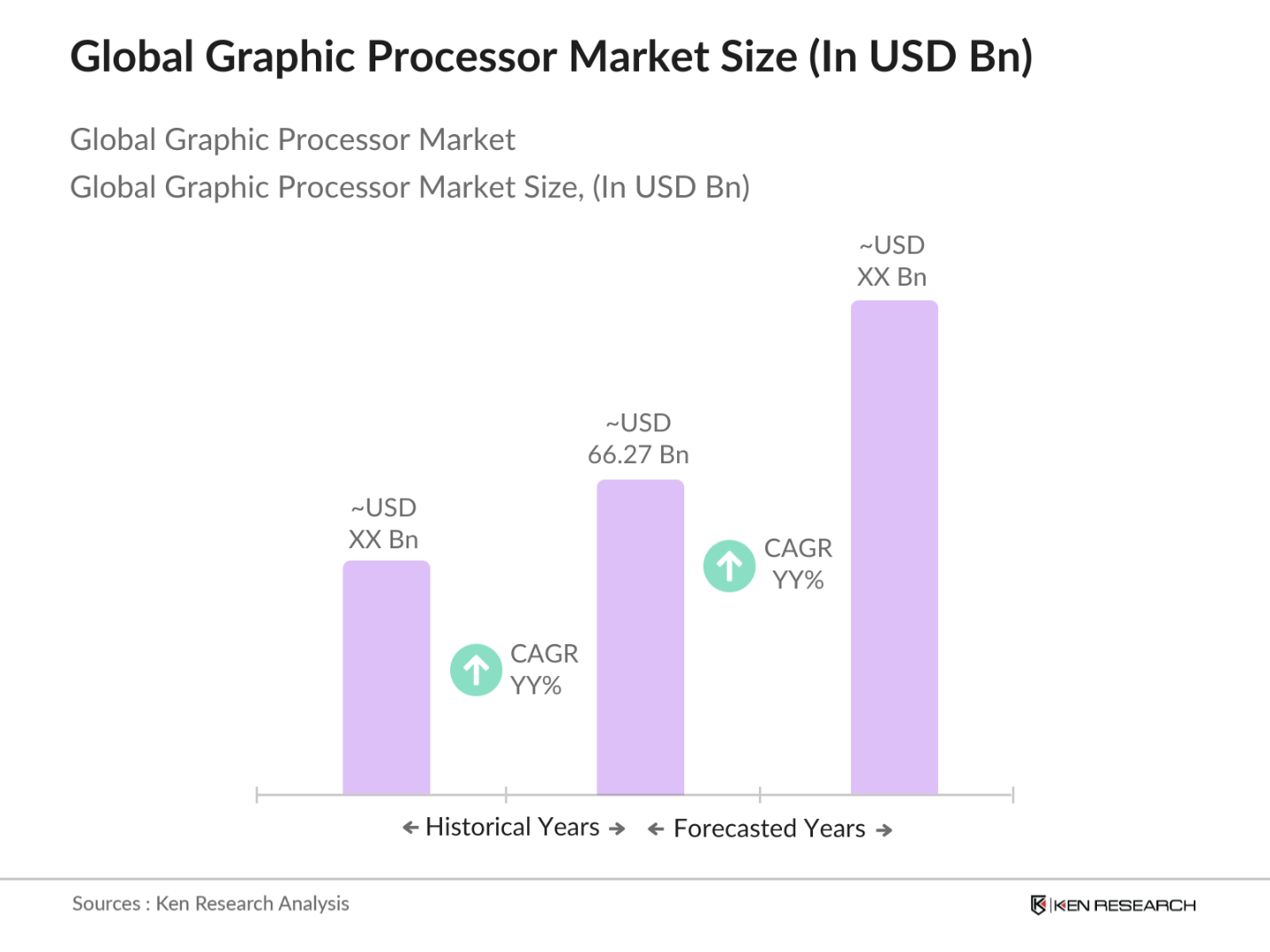
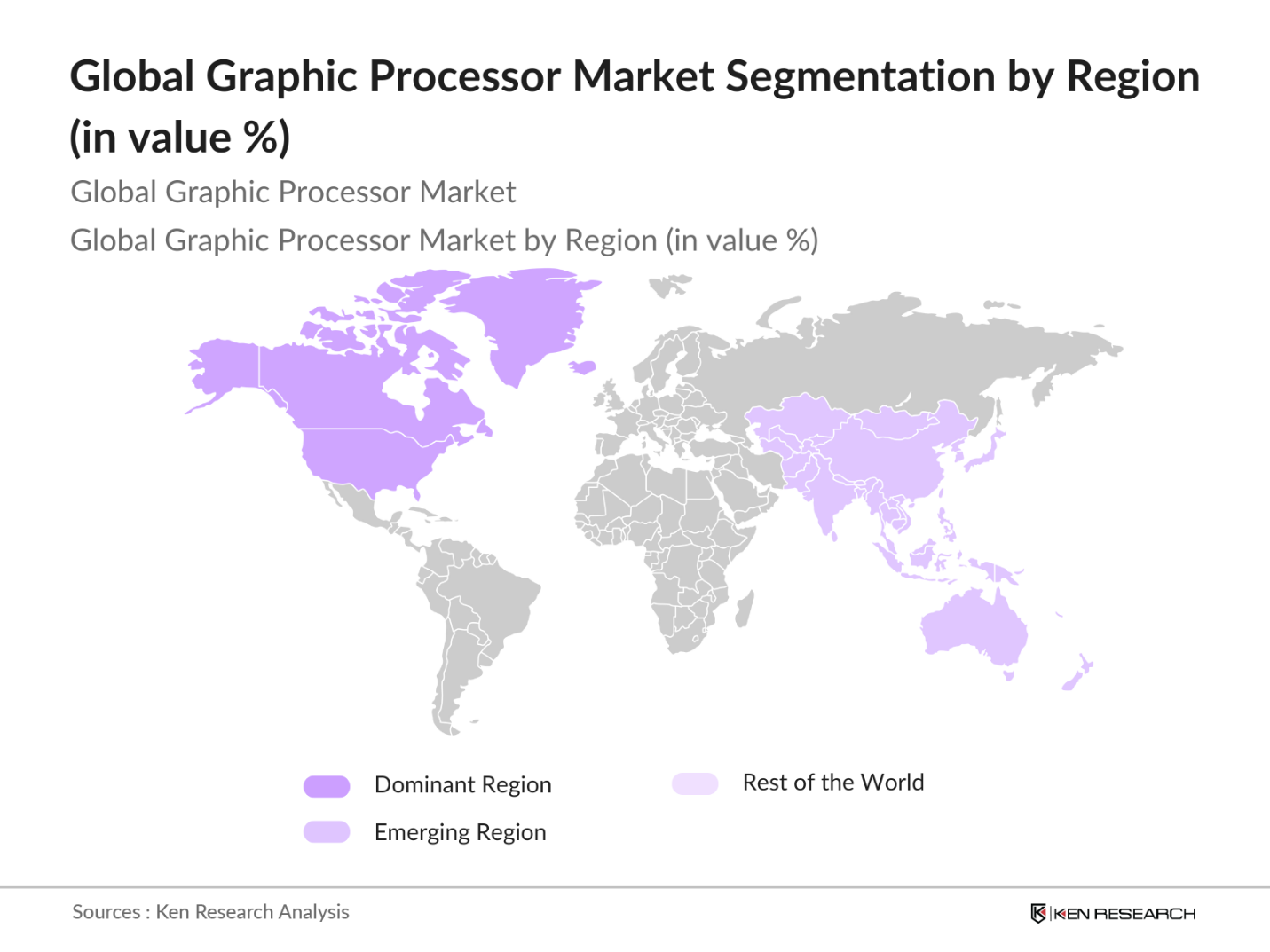
- Dominant regions such as North America, specifically the United States, and countries in the Asia-Pacific region like China and South Korea, are key players in the global GPU market. These regions dominate due to their high adoption of AI-driven technologies, robust demand from the gaming industry, and significant investments in data centers and autonomous vehicles. In North America, a tech-forward ecosystem and strong presence of key players like NVIDIA and AMD contribute to its leading position.
- Governments around the world are establishing standards for graphics processing, particularly in industries such as defense and telecommunications, where high-performance computing is essential. In 2023, the International Telecommunication Union (ITU) introduced new global guidelines for data center graphics processing efficiency, focusing on reducing energy consumption in the coming years. This regulatory environment is pushing GPU manufacturers to innovate in energy-efficient designs, driving the development of more sustainable technologies for data centers and high-performance computing environments.
Global Graphic Processor Market Segmentation
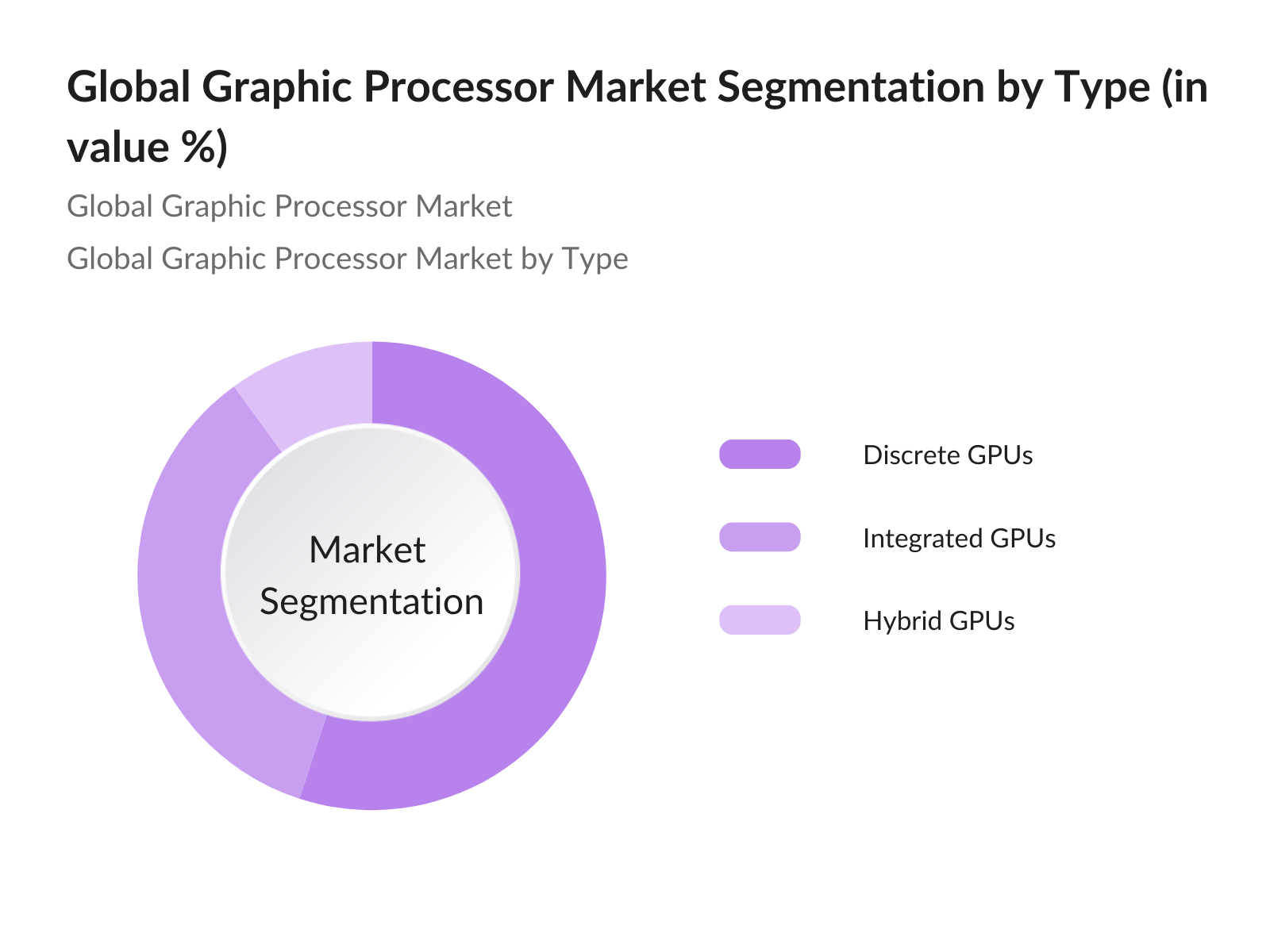
By Type: The global graphic processor market is segmented by type into discrete GPUs, integrated GPUs, and hybrid GPUs. Discrete GPUs hold a dominant share due to their widespread use in gaming consoles, data centers, and automotive applications where high processing power is required. This segment is growing rapidly, driven by demand for dedicated graphics cards in high-performance computing. Companies like NVIDIA and AMD have pioneered this space, offering advanced solutions to meet evolving consumer and industrial needs.
By Region: The North America, Asia-Pacific, Europe, and the Middle East & Africa dominate the graphic processor market. North America leads due to its advanced tech ecosystem and the presence of key industry players like NVIDIA and AMD. The Asia-Pacific region is also showing substantial growth, driven by increasing investments in data centers and the gaming industry. Countries like China and South Korea have emerged as technology hubs, fueling demand for high-performance GPUs.
Global Graphic Processor Market Competitive Landscape
The global graphic processor market is dominated by a few key players, including NVIDIA Corporation, AMD, and Intel. These companies hold significant influence due to their extensive R&D efforts, product innovation, and strong market presence. For example, NVIDIA has revolutionized GPU technology with its CUDA cores, catering to AI, gaming, and industrial markets. Intel is also making strides with integrated GPUs, focusing on power efficiency and performance.
|
Company |
Year Established |
Headquarters |
R&D Investment |
Revenue |
Market Share |
Key Product Lines |
Geographic Presence |
|
NVIDIA Corporation |
1993 |
Santa Clara, USA |
- |
- |
- |
- |
- |
|
Advanced Micro Devices (AMD) |
1969 |
Santa Clara, USA |
- |
- |
- |
- |
- |
|
Intel Corporation |
1968 |
Santa Clara, USA |
- |
- |
- |
- |
- |
|
Qualcomm Technologies Inc. |
1985 |
San Diego, USA |
- |
- |
- |
- |
- |
|
Imagination Technologies Group |
1985 |
Kings Langley, UK |
- |
- |
- |
- |
- |
Global Graphic Processor Market Analysis
Market Growth Drivers
- Technological Advancements (AI, VR, Deep Learning): The demand for high-performance GPUs is being driven by advancements in artificial intelligence (AI), virtual reality (VR), and deep learning technologies. AI has seen significant adoption in industries such as healthcare, manufacturing, and finance. According to the World Bank, global R&D expenditures reached $2.3 trillion in 2023, fueling the development of new AI algorithms and deep learning models, which require sophisticated GPUs to perform complex computations. Moreover, VR applications are expected to enhance training simulations in sectors like defense and education, further increasing GPU adoption for real-time processing.
- Increasing Demand for High-Performance GPUs (Gaming, Data Centers): The gaming industry is a key driver of GPU demand, with an estimated 3 billion gamers worldwide in 2023, according to the World Bank. Additionally, data centers across the globe are expanding their infrastructure to accommodate the growing needs of cloud computing and big data analytics. NVIDIAs A100 GPUs, designed for data centers, have seen increased adoption due to the exponential rise in cloud computing workloads, as observed in a World Bank report. The expansion of AI-driven cloud applications further boosts the demand for high-performance GPUs,
- Automotive and Industrial Applications: The automotive industry is rapidly integrating GPUs into advanced driver-assistance systems (ADAS) and autonomous driving technologies. According to the International Transport Forum (ITF), 21 million cars equipped with semi-autonomous driving systems were sold globally in 2023. GPUs are essential for processing real-time data from various sensors and cameras in autonomous vehicles. Similarly, industries such as manufacturing are utilizing GPUs for real-time monitoring and predictive maintenance, significantly increasing the demand for industrial-grade graphics processors.
Market Challenges:
- High Initial Investments: One of the major challenges in the GPU market is the high cost of developing and manufacturing high-performance GPUs. The global semiconductor R&D expenditure reached $127 billion in 2023, as per the International Trade Administration (ITA). This substantial investment in cutting-edge technologies such as 7nm and 5nm chip fabrication processes contributes to the high price of GPUs. The development of AI-optimized GPUs further raises production costs, limiting access for small and medium-sized enterprises.
- Supply Chain Constraints: The global supply chain for semiconductors and GPUs has faced disruptions due to geopolitical tensions and the ongoing chip shortage. The global semiconductor supply gap affected production volumes by 15 million units in 2023, according to the United Nations Conference on Trade and Development (UNCTAD). This shortage has significantly impacted industries dependent on GPUs, such as automotive and gaming, causing delays and higher procurement costs for manufacturers.
Global Graphic Processor Market Future Outlook
Over the next five years, the global graphic processor market is expected to witness significant growth, driven by continuous technological advancements, growing applications in AI, and expanding demand in gaming and automotive sectors. The increasing integration of GPUs in autonomous vehicles and data centers will play a pivotal role in accelerating market growth. Furthermore, innovations in real-time rendering and cloud computing are anticipated to open new avenues for market players.
Market Opportunities:
- Emerging Markets in APAC: The Asia-Pacific region, especially countries like India and Vietnam, has seen increased investment in digital infrastructure and gaming industries. According to the Asian Development Bank (ADB), digital economy growth in APAC exceeded $3 trillion in 2023, opening new markets for GPU manufacturers. High internet penetration and the rapid adoption of AI-driven applications in these emerging markets create a robust demand for high-performance GPUs.
- Expansion of Cloud Gaming: Cloud gaming is gaining traction as more players shift from physical consoles to cloud-based platforms, offering high-end gaming experiences without the need for expensive hardware. The global cloud gaming market saw 60 million users in 2023, according to a report by the International Telecommunication Union (ITU). GPUs are essential in cloud gaming infrastructure, providing the computational power necessary for rendering high-definition graphics in real-time.
Scope of the Report
|
By Type |
Discrete GPUs Integrated GPUs Hybrid GPUs |
|
By Application |
Gaming Consoles Data Centers Automotive Mobile Devices |
|
By End-User |
Consumer Electronics Automotive Healthcare Manufacturing |
|
By Sales Channel |
OEMs Aftermarket |
|
By Region |
North America Europe Asia-Pacific MEA |
Products
Key Target Audience
Gaming Hardware Manufacturers
Automotive Industry Players
Data Center Providers
Cloud Service Providers
Consumer Electronics Manufacturers
Government and Regulatory Bodies (Federal Communications Commission, Ministry of Industry and Information Technology)
Investments and Venture Capitalist Firms
AI and Machine Learning Companies
Companies
Major Players
NVIDIA Corporation
Advanced Micro Devices, Inc. (AMD)
Intel Corporation
Qualcomm Technologies, Inc.
Samsung Electronics Co., Ltd.
Imagination Technologies Group
ARM Holdings
Broadcom Corporation
Matrox Electronic Systems Ltd.
Vivante Corporation
SAPPHIRE Technology Limited
EVGA Corporation
VIA Technologies, Inc.
3DLabs Inc.
Apple Inc.
Table of Contents
1. Global Graphic Processor Market Overview
1.1 Definition and Scope
1.2 Market Taxonomy
1.3 Market Growth Rate
1.4 Market Segmentation Overview
2. Global Graphic Processor Market Size (In USD Mn)
2.1 Historical Market Size
2.2 Year-on-Year Growth Analysis
2.3 Key Market Developments and Milestones
3. Global Graphic Processor Market Analysis
3.1 Growth Drivers
Technological Advancements (AI, VR, Deep Learning)
Increasing Demand for High-Performance GPUs (Gaming, Data Centers)
Automotive and Industrial Applications
3.2 Market Challenges
High Initial Investments
Supply Chain Constraints
Competition from Integrated Graphics Solutions
3.3 Opportunities
Emerging Markets in APAC
Real-Time Computing and Edge AI Applications
Expansion of Cloud Gaming
3.4 Trends
Rise of AI and Machine Learning Workloads
Shift Toward Hybrid and Discrete GPUs
Integration of GPUs in Autonomous Vehicles
3.5 Government Regulation
Global Standards for Graphics Processing
Incentives for Advanced Computing Technologies
Data Privacy and GPU Encryption
3.6 SWOT Analysis
3.7 Stakeholder Ecosystem
3.8 Porters Five Forces
3.9 Competition Ecosystem
4. Global Graphic Processor Market Segmentation
4.1 By Type (In Value %)
Discrete GPUs
Integrated GPUs
Hybrid GPUs
4.2 By Application (In Value %)
Gaming Consoles
Data Centers
Automotive (ADAS, In-Vehicle Displays)
Mobile Devices
4.3 By End-User (In Value %)
Consumer Electronics
Automotive
Healthcare
Manufacturing
4.4 By Sales Channel (In Value %)
OEMs
Aftermarket
4.5 By Region (In Value %)
North America
Europe
Asia-Pacific
Middle East and Africa
5. Global Graphic Processor Market Competitive Analysis
5.1 Detailed Profiles of Major Companies
5.1.1 NVIDIA Corporation
5.1.2 Advanced Micro Devices, Inc. (AMD)
5.1.3 Intel Corporation
5.1.4 Qualcomm Technologies, Inc.
5.1.5 Samsung Electronics Co., Ltd.
5.1.6 Imagination Technologies Group
5.1.7 ARM Holdings
5.1.8 Broadcom Corporation
5.1.9 Matrox Electronic Systems Ltd.
5.1.10 Vivante Corporation
5.1.11 SAPPHIRE Technology Limited
5.1.12 EVGA Corporation
5.1.13 VIA Technologies, Inc.
5.1.14 3DLabs Inc.
5.1.15 Apple Inc.
5.2 Cross Comparison Parameters (Revenue, Market Share, R&D Investment, Product Portfolio, Regional Presence, Sales Volume, Innovation Index, Strategic Partnerships)
5.3 Market Share Analysis
5.4 Strategic Initiatives
5.5 Mergers and Acquisitions
5.6 Investment Analysis
5.7 Venture Capital Funding
5.8 Government Grants
5.9 Private Equity Investments
6. Global Graphic Processor Market Regulatory Framework
6.1 Environmental Standards for Production
6.2 Compliance Requirements for GPUs in Critical Applications
6.3 Certification and Licensing
7. Global Graphic Processor Future Market Size (In USD Mn)
7.1 Future Market Size Projections
7.2 Key Factors Driving Future Market Growth
8. Global Graphic Processor Future Market Segmentation
8.1 By Type (In Value %)
8.2 By Application (In Value %)
8.3 By Region (In Value %)
9. Global Graphic Processor Market Analysts Recommendations
9.1 TAM/SAM/SOM Analysis
9.2 Customer Cohort Analysis
9.3 Product Differentiation and Innovation Strategies
9.4 White Space Opportunity Analysis
Research Methodology
Step 1: Identification of Key Variables
The initial phase involves identifying key variables affecting the global graphic processor market, such as technological advancements, adoption rates, and industry regulations. Extensive desk research and proprietary databases are utilized to gather comprehensive market data.
Step 2: Market Analysis and Construction
This step involves analyzing historical data to estimate the market size and trends in the GPU industry. Data from leading GPU manufacturers and industry stakeholders is compiled to generate accurate revenue models.
Step 3: Hypothesis Validation and Expert Consultation
We validate market hypotheses through expert interviews and consultations with GPU industry leaders. This helps in refining projections and gaining insights into operational and financial aspects.
Step 4: Research Synthesis and Final Output
The final step consolidates research findings and verifies them through direct industry engagement. Detailed insights on market segments, consumer preferences, and competitive analysis are compiled to produce a comprehensive market report.
Frequently Asked Questions
01. How big is the global graphic processor market?
The global graphic processor market is valued at USD 66.27 billion, driven by increasing demand for high-performance GPUs in gaming, data centers, and automotive applications.
02. What are the challenges in the graphic processor market?
Challenges include high initial costs, supply chain constraints, and competition from integrated graphics solutions, which can offer cost-effective alternatives in some applications.
03. Who are the major players in the global graphic processor market?
Key players in the market include NVIDIA Corporation, AMD, Intel Corporation, Qualcomm Technologies, and Samsung Electronics, each of whom plays a significant role in innovation and market dynamics.
04. What drives growth in the graphic processor market?
The market is propelled by increasing demand for advanced graphics in gaming, the expansion of AI-driven applications, and the rising need for GPUs in data centers and autonomous vehicles.
Why Buy From Us?

What makes us stand out is that our consultants follows Robust, Refine and Result (RRR) methodology. i.e. Robust for clear definitions, approaches and sanity checking, Refine for differentiating respondents facts and opinions and Result for presenting data with story

We have set a benchmark in the industry by offering our clients with syndicated and customized market research reports featuring coverage of entire market as well as meticulous research and analyst insights.

While we don't replace traditional research, we flip the method upside down. Our dual approach of Top Bottom & Bottom Top ensures quality deliverable by not just verifying company fundamentals but also looking at the sector and macroeconomic factors.

With one step in the future, our research team constantly tries to show you the bigger picture. We help with some of the tough questions you may encounter along the way: How is the industry positioned? Best marketing channel? KPI's of competitors? By aligning every element, we help maximize success.

Our report gives you instant access to the answers and sources that other companies might choose to hide. We elaborate each steps of research methodology we have used and showcase you the sample size to earn your trust.

If you need any support, we are here! We pride ourselves on universe strength, data quality, and quick, friendly, and professional service.