About the Report
Base Year 2024US Cloud Infrastructure for Healthcare Data Market Overview
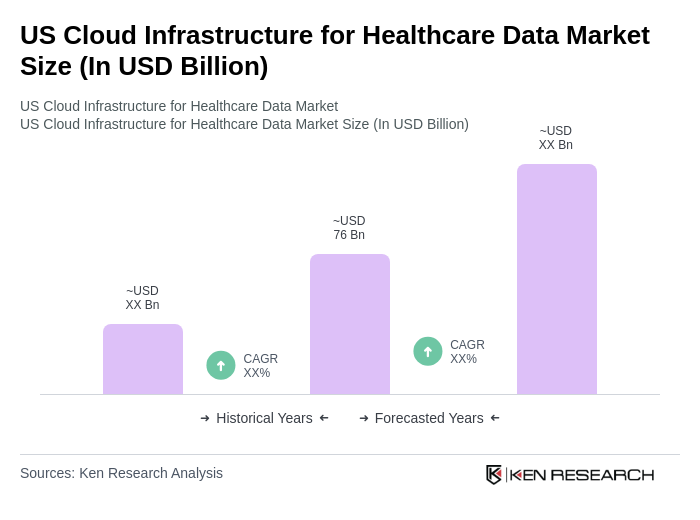
- The US Cloud Infrastructure for Healthcare Data Market is valued at approximatelyUSD 76 billion, based on the most recent market analysis. Growth is driven by the rapid adoption of digital health solutions, the need for secure and scalable data storage, and increasing demand for efficient healthcare service delivery. Additional drivers include the proliferation of electronic health records, telemedicine expansion, and the integration of advanced analytics and artificial intelligence in clinical workflows, all of which require robust cloud infrastructure solutions .
- Key regions in this market include major cities such as New York, San Francisco, and Chicago, which lead due to their advanced healthcare ecosystems, concentration of technology firms, and significant investment in healthcare innovation. States like California and Texas are also pivotal, supported by large populations and robust healthcare infrastructure, creating a favorable environment for cloud adoption .
- The 21st Century Cures Act (Public Law 114-255, issued by the US Congress in 2016 and enforced by the Office of the National Coordinator for Health Information Technology) mandates healthcare providers to implement interoperable electronic health records (EHR) systems. This regulation requires providers to ensure patient data accessibility, prohibits information blocking, and enforces compliance with technical standards for interoperability, thereby accelerating demand for cloud infrastructure solutions that meet these requirements .
US Cloud Infrastructure for Healthcare Data Market Segmentation
By Type:The market is segmented into Public Cloud, Private Cloud, Hybrid Cloud, Multi-Cloud, and Community Cloud. Each segment addresses distinct organizational needs and compliance requirements, shaping adoption patterns. Public cloud solutions are favored for scalability and cost-effectiveness, while hybrid and multi-cloud models are increasingly adopted to balance security, compliance, and operational flexibility. The hybrid cloud segment is experiencing notable growth as healthcare organizations seek to optimize sensitive data management and regulatory compliance while leveraging public cloud scalability .
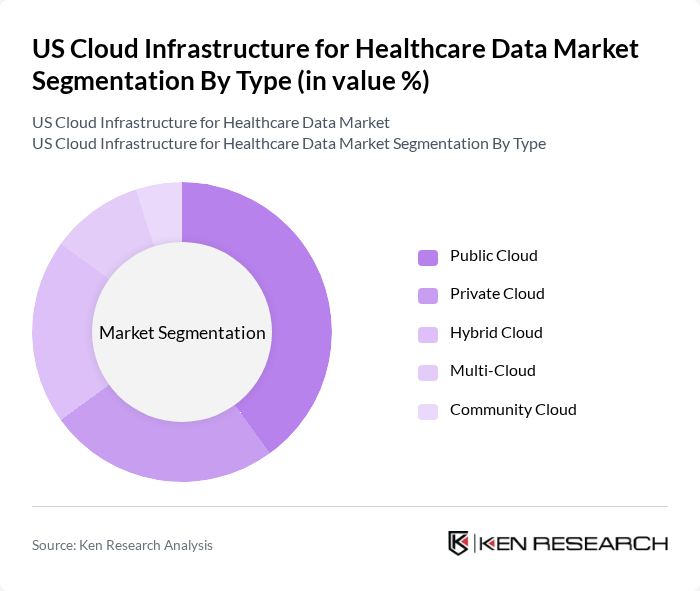
ThePublic Cloudsegment leads the market due to its scalability, cost-efficiency, and accessibility. Healthcare organizations are increasingly adopting public cloud platforms to manage data efficiently and ensure regulatory compliance. The flexibility and rapid deployment capabilities of public cloud services enable healthcare providers to respond swiftly to evolving operational demands. Hybrid and multi-cloud models are also gaining traction as organizations seek to optimize data security and compliance while maintaining operational agility .
By End-User:This segmentation includes Hospitals & Health Systems, Physician Groups & Clinics, Health Insurance Providers, Pharmaceutical & Life Sciences Companies, Diagnostic Laboratories, Government & Public Health Agencies, and Others. Each end-user group has specific requirements influencing their cloud infrastructure strategies. Hospitals and health systems require extensive data management and integration capabilities, while insurers and life sciences firms prioritize secure, scalable, and interoperable solutions .
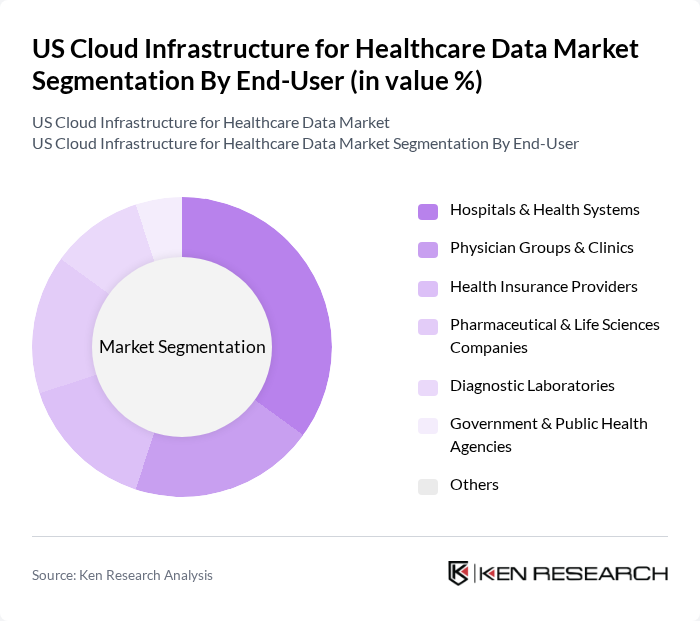
Hospitals & Health Systemsdominate the market, reflecting their substantial data management needs and the critical importance of patient care. The sector’s focus on digital transformation, interoperability, and regulatory compliance has driven significant investment in cloud infrastructure to enhance operational efficiency, support advanced analytics, and improve patient outcomes .
US Cloud Infrastructure for Healthcare Data Market Competitive Landscape
The US Cloud Infrastructure for Healthcare Data Market is characterized by a dynamic mix of regional and international players. Leading participants such as Amazon Web Services, Inc. (AWS), Microsoft Corporation (Azure), Google Cloud Platform (GCP), IBM Corporation, Oracle Corporation, Salesforce, Inc., Dell Technologies Inc., Cisco Systems, Inc., VMware, Inc., Rackspace Technology, Inc., Cerner Corporation (now part of Oracle Health), Allscripts Healthcare Solutions, Inc. (now Veradigm Inc.), MEDITECH, Epic Systems Corporation, athenahealth, Inc., InterSystems Corporation, Change Healthcare (part of UnitedHealth Group), Optum (UnitedHealth Group), Philips Healthcare (Philips USA), GE HealthCare Technologies Inc. contribute to innovation, geographic expansion, and service delivery in this space.
US Cloud Infrastructure for Healthcare Data Market Industry Analysis
Growth Drivers
- Increasing Demand for Data Security and Compliance:The healthcare sector is projected to allocate approximately $125 billion in cybersecurity measures in future, driven by the need for robust data protection. With over 80% of healthcare organizations reporting data breaches, compliance with regulations like HIPAA is paramount. The rising costs associated with data breaches, averaging $4.45 million per incident, further emphasize the urgency for secure cloud infrastructure solutions that ensure compliance and protect sensitive patient information.
- Rising Adoption of Telehealth Services:The telehealth market is expected to reach $175 billion in future, reflecting a significant shift in healthcare delivery models. This surge is fueled by the COVID-19 pandemic, which accelerated telehealth adoption by over 38 times. As healthcare providers increasingly rely on cloud infrastructure to support virtual consultations, the demand for scalable and reliable cloud solutions is expected to grow, enhancing patient access and care continuity.
- Growth in Healthcare Data Analytics:The healthcare analytics market is projected to reach $50 billion in future, driven by the need for data-driven decision-making. With healthcare data expected to grow to 2,314 exabytes in future, organizations are increasingly leveraging cloud infrastructure to analyze vast datasets. This trend is supported by the need for improved patient outcomes and operational efficiencies, as analytics enable predictive modeling and personalized care strategies.
Market Challenges
- Data Privacy Concerns:Data privacy remains a significant challenge, with 60% of healthcare organizations expressing concerns over patient data security. The increasing frequency of cyberattacks, which have risen by 55% since 2020, exacerbates these fears. As healthcare providers transition to cloud solutions, they must navigate complex privacy regulations and ensure that their systems are equipped to handle sensitive information securely, which can hinder adoption rates.
- Integration with Legacy Systems:Approximately 70% of healthcare organizations still rely on legacy systems, which complicate the integration of new cloud solutions. The costs associated with upgrading or replacing these systems can exceed $1 million per organization. This challenge not only delays the adoption of cloud infrastructure but also increases operational inefficiencies, as organizations struggle to maintain interoperability between old and new systems.
US Cloud Infrastructure for Healthcare Data Market Future Outlook
The future of the US cloud infrastructure for healthcare data market is poised for transformative growth, driven by technological advancements and evolving patient care models. As healthcare organizations increasingly adopt hybrid cloud solutions, the focus will shift towards enhancing data interoperability and patient-centric care. Additionally, the integration of AI and machine learning technologies will enable more efficient data management and analytics, ultimately improving patient outcomes and operational efficiencies across the sector.
Market Opportunities
- Expansion of Cloud-Based EHR Systems:The market for cloud-based Electronic Health Records (EHR) is expected to grow significantly, with an estimated 60% of healthcare providers planning to transition to cloud solutions in future. This shift presents a substantial opportunity for cloud service providers to offer tailored solutions that enhance data accessibility and streamline workflows, ultimately improving patient care.
- Increased Funding for Healthcare IT Innovations:In future, healthcare IT investments are projected to exceed $200 billion, driven by government initiatives and private sector funding. This influx of capital will create opportunities for cloud infrastructure providers to develop innovative solutions that address emerging healthcare challenges, such as telehealth integration and advanced data analytics, fostering a more efficient healthcare ecosystem.
Scope of the Report
| Segment | Sub-Segments |
|---|---|
| By Type | Public Cloud Private Cloud Hybrid Cloud Multi-Cloud Community Cloud |
| By End-User | Hospitals & Health Systems Physician Groups & Clinics Health Insurance Providers Pharmaceutical & Life Sciences Companies Diagnostic Laboratories Government & Public Health Agencies Others |
| By Application | Electronic Health Records (EHR) Telemedicine & Virtual Care Healthcare Data Analytics & Population Health Patient Management Systems Medical Imaging Storage & Sharing Genomics & Precision Medicine Others |
| By Deployment Model | On-Premises Cloud-Based Hybrid Edge Computing Others |
| By Service Type | Infrastructure as a Service (IaaS) Platform as a Service (PaaS) Software as a Service (SaaS) Disaster Recovery as a Service (DRaaS) Security as a Service Others |
| By Compliance Standards | HIPAA HITECH ISO/IEC 27001 SOC 2 Others |
| By Pricing Model | Subscription-Based Pay-As-You-Go Tiered Pricing Enterprise Licensing Others |
Key Target Audience
Investors and Venture Capitalist Firms
Government and Regulatory Bodies (e.g., Centers for Medicare & Medicaid Services, Food and Drug Administration)
Healthcare Providers and Organizations
Cloud Service Providers
Data Security and Compliance Firms
Health Information Technology Vendors
Insurance Companies
Healthcare Industry Associations
Players Mentioned in the Report:
Amazon Web Services, Inc. (AWS)
Microsoft Corporation (Azure)
Google Cloud Platform (GCP)
IBM Corporation
Oracle Corporation
Salesforce, Inc.
Dell Technologies Inc.
Cisco Systems, Inc.
VMware, Inc.
Rackspace Technology, Inc.
Cerner Corporation (now part of Oracle Health)
Allscripts Healthcare Solutions, Inc. (now Veradigm Inc.)
MEDITECH
Epic Systems Corporation
athenahealth, Inc.
InterSystems Corporation
Change Healthcare (part of UnitedHealth Group)
Optum (UnitedHealth Group)
Philips Healthcare (Philips USA)
GE HealthCare Technologies Inc.
Table of Contents
Market Assessment Phase
1. Executive Summary and Approach
2. US Cloud Infrastructure for Healthcare Data Market Overview
2.1 Key Insights and Strategic Recommendations
2.2 US Cloud Infrastructure for Healthcare Data Market Overview
2.3 Definition and Scope
2.4 Evolution of Market Ecosystem
2.5 Timeline of Key Regulatory Milestones
2.6 Value Chain & Stakeholder Mapping
2.7 Business Cycle Analysis
2.8 Policy & Incentive Landscape
3. US Cloud Infrastructure for Healthcare Data Market Analysis
3.1 Growth Drivers
3.1.1 Increasing demand for data security and compliance
3.1.2 Rising adoption of telehealth services
3.1.3 Need for scalable and flexible IT solutions
3.1.4 Growth in healthcare data analytics
3.2 Market Challenges
3.2.1 Data privacy concerns
3.2.2 High initial investment costs
3.2.3 Integration with legacy systems
3.2.4 Regulatory compliance complexities
3.3 Market Opportunities
3.3.1 Expansion of cloud-based EHR systems
3.3.2 Increased funding for healthcare IT innovations
3.3.3 Partnerships with technology providers
3.3.4 Growth in AI and machine learning applications
3.4 Market Trends
3.4.1 Shift towards hybrid cloud solutions
3.4.2 Emphasis on patient-centric care models
3.4.3 Rise of data interoperability standards
3.4.4 Increased focus on cybersecurity measures
3.5 Government Regulation
3.5.1 HIPAA compliance requirements
3.5.2 FDA regulations on digital health technologies
3.5.3 CMS guidelines for cloud services
3.5.4 State-level data protection laws
4. SWOT Analysis
5. Stakeholder Analysis
6. Porter's Five Forces Analysis
7. US Cloud Infrastructure for Healthcare Data Market Market Size, 2019-2024
7.1 By Value
7.2 By Volume
7.3 By Average Selling Price
8. US Cloud Infrastructure for Healthcare Data Market Segmentation
8.1 By Type
8.1.1 Public Cloud
8.1.2 Private Cloud
8.1.3 Hybrid Cloud
8.1.4 Multi-Cloud
8.1.5 Community Cloud
8.2 By End-User
8.2.1 Hospitals & Health Systems
8.2.2 Physician Groups & Clinics
8.2.3 Health Insurance Providers
8.2.4 Pharmaceutical & Life Sciences Companies
8.2.5 Diagnostic Laboratories
8.2.6 Government & Public Health Agencies
8.2.7 Others
8.3 By Application
8.3.1 Electronic Health Records (EHR)
8.3.2 Telemedicine & Virtual Care
8.3.3 Healthcare Data Analytics & Population Health
8.3.4 Patient Management Systems
8.3.5 Medical Imaging Storage & Sharing
8.3.6 Genomics & Precision Medicine
8.3.7 Others
8.4 By Deployment Model
8.4.1 On-Premises
8.4.2 Cloud-Based
8.4.3 Hybrid
8.4.4 Edge Computing
8.4.5 Others
8.5 By Service Type
8.5.1 Infrastructure as a Service (IaaS)
8.5.2 Platform as a Service (PaaS)
8.5.3 Software as a Service (SaaS)
8.5.4 Disaster Recovery as a Service (DRaaS)
8.5.5 Security as a Service
8.5.6 Others
8.6 By Compliance Standards
8.6.1 HIPAA
8.6.2 HITECH
8.6.3 ISO/IEC 27001
8.6.4 SOC 2
8.6.5 Others
8.7 By Pricing Model
8.7.1 Subscription-Based
8.7.2 Pay-As-You-Go
8.7.3 Tiered Pricing
8.7.4 Enterprise Licensing
8.7.5 Others
9. US Cloud Infrastructure for Healthcare Data Market Competitive Analysis
9.1 Market Share of Key Players
9.2 Cross Comparison of Key Players
9.2.1 Company Name
9.2.2 Group Size (Large, Medium, or Small as per industry convention)
9.2.3 Number of Healthcare Clients
9.2.4 Data Center Locations (US-based)
9.2.5 Customer Acquisition Cost (CAC)
9.2.6 Customer Lifetime Value (CLV)
9.2.7 Monthly Recurring Revenue (MRR)
9.2.8 Churn Rate
9.2.9 Average Revenue Per User (ARPU)
9.2.10 Pricing Strategy
9.2.11 Market Penetration Rate (Healthcare vertical)
9.2.12 Service Level Agreement (SLA) Compliance Rate
9.2.13 HITRUST Certification Status
9.2.14 Interoperability Capabilities
9.2.15 Uptime Percentage
9.2.16 Data Breach Incidents (last 5 years)
9.2.17 Investment in R&D (Healthcare cloud)
9.2.18 Support for AI/ML Workloads
9.2.19 Compliance with HIPAA/HITECH
9.2.20 Healthcare-Specific Partnerships
9.3 SWOT Analysis of Top Players
9.4 Pricing Analysis
9.5 Detailed Profile of Major Companies
9.5.1 Amazon Web Services, Inc. (AWS)
9.5.2 Microsoft Corporation (Azure)
9.5.3 Google Cloud Platform (GCP)
9.5.4 IBM Corporation
9.5.5 Oracle Corporation
9.5.6 Salesforce, Inc.
9.5.7 Dell Technologies Inc.
9.5.8 Cisco Systems, Inc.
9.5.9 VMware, Inc.
9.5.10 Rackspace Technology, Inc.
9.5.11 Cerner Corporation (now part of Oracle Health)
9.5.12 Allscripts Healthcare Solutions, Inc. (now Veradigm Inc.)
9.5.13 MEDITECH
9.5.14 Epic Systems Corporation
9.5.15 athenahealth, Inc.
9.5.16 InterSystems Corporation
9.5.17 Change Healthcare (part of UnitedHealth Group)
9.5.18 Optum (UnitedHealth Group)
9.5.19 Philips Healthcare (Philips USA)
9.5.20 GE HealthCare Technologies Inc.
10. US Cloud Infrastructure for Healthcare Data Market End-User Analysis
10.1 Procurement Behavior of Key Ministries
10.1.1 Budget Allocation Trends
10.1.2 Decision-Making Processes
10.1.3 Vendor Selection Criteria
10.2 Corporate Spend on Infrastructure & Energy
10.2.1 Investment Priorities
10.2.2 Cost Management Strategies
10.2.3 Infrastructure Upgrades
10.3 Pain Point Analysis by End-User Category
10.3.1 Data Security Concerns
10.3.2 Integration Challenges
10.3.3 Compliance Issues
10.4 User Readiness for Adoption
10.4.1 Training and Support Needs
10.4.2 Technology Familiarity
10.4.3 Change Management Strategies
10.5 Post-Deployment ROI and Use Case Expansion
10.5.1 Performance Metrics
10.5.2 User Feedback Mechanisms
10.5.3 Future Use Case Development
11. US Cloud Infrastructure for Healthcare Data Market Future Size, 2025-2030
11.1 By Value
11.2 By Volume
11.3 By Average Selling Price
Go-To-Market Strategy Phase
1. Whitespace Analysis + Business Model Canvas
1.1 Market Gaps Identification
1.2 Value Proposition Development
1.3 Revenue Streams Analysis
1.4 Cost Structure Evaluation
1.5 Key Partnerships Exploration
1.6 Customer Segmentation
1.7 Channels and Customer Relationships
2. Marketing and Positioning Recommendations
2.1 Branding Strategies
2.2 Product USPs
2.3 Target Audience Identification
2.4 Communication Strategies
2.5 Digital Marketing Approaches
3. Distribution Plan
3.1 Urban Retail Strategies
3.2 Rural NGO Tie-Ups
3.3 Online Distribution Channels
3.4 Direct Sales Approaches
4. Channel & Pricing Gaps
4.1 Underserved Routes
4.2 Pricing Bands Analysis
4.3 Competitor Pricing Comparison
5. Unmet Demand & Latent Needs
5.1 Category Gaps
5.2 Consumer Segments Analysis
5.3 Emerging Trends Identification
6. Customer Relationship
6.1 Loyalty Programs
6.2 After-Sales Service
6.3 Customer Feedback Mechanisms
7. Value Proposition
7.1 Sustainability Initiatives
7.2 Integrated Supply Chains
7.3 Competitive Advantages
8. Key Activities
8.1 Regulatory Compliance
8.2 Branding Efforts
8.3 Distribution Setup
9. Entry Strategy Evaluation
9.1 Domestic Market Entry Strategy
9.1.1 Product Mix Considerations
9.1.2 Pricing Band Strategies
9.1.3 Packaging Options
9.2 Export Entry Strategy
9.2.1 Target Countries Analysis
9.2.2 Compliance Roadmap Development
10. Entry Mode Assessment
10.1 Joint Ventures
10.2 Greenfield Investments
10.3 Mergers & Acquisitions
10.4 Distributor Model Evaluation
11. Capital and Timeline Estimation
11.1 Capital Requirements
11.2 Timelines for Implementation
12. Control vs Risk Trade-Off
12.1 Ownership Considerations
12.2 Partnerships Evaluation
13. Profitability Outlook
13.1 Breakeven Analysis
13.2 Long-Term Sustainability Strategies
14. Potential Partner List
14.1 Distributors
14.2 Joint Ventures
14.3 Acquisition Targets
15. Execution Roadmap
15.1 Phased Plan for Market Entry
15.1.1 Market Setup
15.1.2 Market Entry
15.1.3 Growth Acceleration
15.1.4 Scale & Stabilize
15.2 Key Activities and Milestones
15.2.1 Milestone Planning
15.2.2 Activity Tracking
Research Methodology
Phase 1: Approach1
Desk Research
- Analysis of industry reports from healthcare IT organizations and cloud service providers
- Review of government publications and healthcare regulations impacting cloud infrastructure
- Examination of market trends and forecasts from reputable healthcare analytics firms
Primary Research
- Interviews with IT managers and cloud architects in healthcare organizations
- Surveys targeting healthcare administrators and decision-makers regarding cloud adoption
- Focus groups with healthcare professionals discussing data management challenges
Validation & Triangulation
- Cross-validation of findings through multiple data sources including market reports and expert opinions
- Triangulation of qualitative insights from interviews with quantitative data from surveys
- Sanity checks through expert panel reviews consisting of healthcare IT specialists
Phase 2: Market Size Estimation1
Top-down Assessment
- Estimation of total healthcare IT spending and allocation towards cloud infrastructure
- Segmentation of market size by healthcare verticals such as hospitals, clinics, and telehealth
- Incorporation of growth rates from cloud adoption trends in the healthcare sector
Bottom-up Modeling
- Collection of data on cloud service usage from leading healthcare providers
- Estimation of average spending on cloud services per healthcare organization
- Volume x cost analysis based on service types such as storage, computing, and analytics
Forecasting & Scenario Analysis
- Multi-factor regression analysis incorporating factors like regulatory changes and technological advancements
- Scenario modeling based on varying rates of cloud adoption and healthcare spending
- Baseline, optimistic, and pessimistic forecasts through 2030 based on market dynamics
Phase 3: CATI Sample Composition1
| Scope Item/Segment | Sample Size | Target Respondent Profiles |
|---|---|---|
| Cloud Adoption in Hospitals | 120 | IT Directors, Chief Information Officers |
| Telehealth Service Providers | 90 | Operations Managers, Telehealth Coordinators |
| Data Security in Healthcare | 60 | Compliance Officers, Data Protection Managers |
| Cloud Infrastructure for Clinics | 50 | Practice Managers, IT Support Staff |
| Healthcare Analytics Solutions | 70 | Data Analysts, Business Intelligence Managers |
Frequently Asked Questions
What is the current value of the US Cloud Infrastructure for Healthcare Data Market?
The US Cloud Infrastructure for Healthcare Data Market is valued at approximately USD 76 billion, driven by the rapid adoption of digital health solutions, secure data storage needs, and the integration of advanced analytics and artificial intelligence in healthcare workflows.
What factors are driving the growth of the US Cloud Infrastructure for Healthcare Data Market?
Which regions are leading in the US Cloud Infrastructure for Healthcare Data Market?
How does the 21st Century Cures Act impact the cloud infrastructure market?
Other Regional/Country Reports
Indonesia Cloud Infrastructure for Healthcare Data Market
Malaysia Cloud Infrastructure for Healthcare Data Market
KSA Cloud Infrastructure for Healthcare Data Market
APAC Cloud Infrastructure for Healthcare Data Market
SEA Cloud Infrastructure for Healthcare Data Market
Vietnam Cloud Infrastructure for Healthcare Data Market
Why Buy From Us?

What makes us stand out is that our consultants follow Robust, Refine and Result (RRR) methodology. Robust for clear definitions, approaches and sanity checking, Refine for differentiating respondents' facts and opinions, and Result for presenting data with story.

We have set a benchmark in the industry by offering our clients with syndicated and customized market research reports featuring coverage of entire market as well as meticulous research and analyst insights.

While we don't replace traditional research, we flip the method upside down. Our dual approach of Top Bottom & Bottom Top ensures quality deliverable by not just verifying company fundamentals but also looking at the sector and macroeconomic factors.

With one step in the future, our research team constantly tries to show you the bigger picture. We help with some of the tough questions you may encounter along the way: How is the industry positioned? Best marketing channel? KPI's of competitors? By aligning every element, we help maximize success.

Our report gives you instant access to the answers and sources that other companies might choose to hide. We elaborate each steps of research methodology we have used and showcase you the sample size to earn your trust.

If you need any support, we are here! We pride ourselves on universe strength, data quality, and quick, friendly, and professional service.