About the Report
Base Year 2024Indonesia Mobility Aid Market Overview
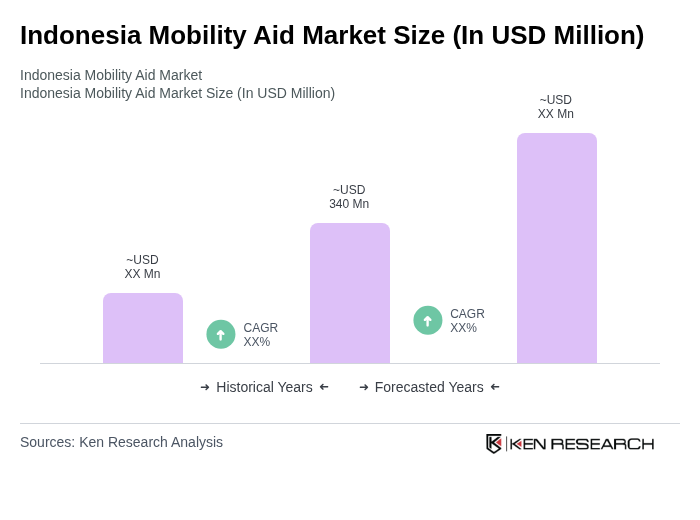
- The Indonesia Mobility Aid Market is valued at USD 340 million, based on a five-year historical analysis of disabled and elderly assistive devices and active wheelchair segment data for the country. This growth is primarily driven by an increasing elderly population, rising awareness of mobility solutions, and government initiatives aimed at improving healthcare accessibility. The demand for mobility aids is further fueled by advancements in technology, such as lightweight foldable devices, powered wheelchairs, and smart assistive features, leading to the development of innovative products that enhance user experience and independence.
- Key cities such as Jakarta, Surabaya, and Bandung dominate the market due to their high population density and urbanization. These cities have a significant number of healthcare facilities and rehabilitation centers, which contribute to the demand for mobility aids. Additionally, the presence of major distributors and retailers in these urban areas, along with growing e?commerce channels for medical devices, facilitates easier access to mobility solutions for consumers.
- In 2023, the Indonesian government strengthened disability inclusion and accessibility requirements for healthcare providers under Law Number 8 of 2016 on Persons with Disabilities and its implementing regulations, which mandate equal access to health services and reasonable accommodation for persons with disabilities, including the provision and facilitation of assistive devices within health facilities. These provisions aim to enhance the quality of care and ensure that individuals with mobility challenges receive the necessary support, thereby supporting the demand for mobility aids across the country.
Indonesia Mobility Aid Market Segmentation
By Product Type:The product type segmentation includes various mobility aids designed to assist individuals with mobility challenges. The subsegments are Manual Wheelchairs, Powered Wheelchairs, Mobility Scooters, Walkers and Rollators, Canes and Crutches, Stair Lifts and Platform Lifts, Robotic Exoskeletons, and Other Mobility Aids. Among these, Manual Wheelchairs and Powered Wheelchairs are the most popular due to their widespread use in both homecare and institutional settings, with manual wheelchairs currently representing the larger share in Indonesia’s active wheelchair segment. The increasing preference for powered options is driven by technological advancements, including compact motors, improved batteries, and smart control interfaces, and by the need for enhanced mobility solutions for elderly and disabled users seeking greater independence.

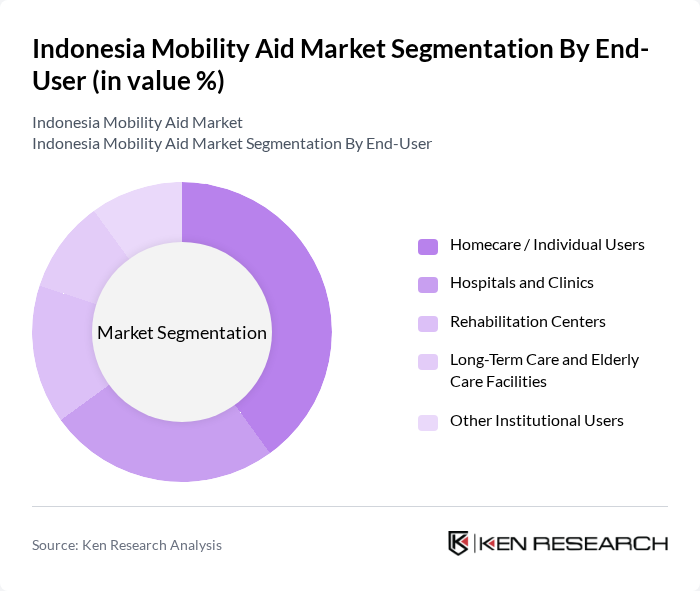
By End-User:The end-user segmentation encompasses various categories including Homecare / Individual Users, Hospitals and Clinics, Rehabilitation Centers, Long-Term Care and Elderly Care Facilities, and Other Institutional Users. Homecare / Individual Users represent the largest segment, driven by the growing elderly population, higher prevalence of chronic and degenerative conditions, and the increasing trend of aging in place supported by assistive technologies. Hospitals and Clinics also contribute significantly to the market, as they require mobility aids for acute care, post-surgical rehabilitation, and long-term management of mobility impairments, while rehabilitation centers and eldercare facilities increasingly integrate advanced wheelchairs, walkers, and other aids into standardized care pathways.
Indonesia Mobility Aid Market Competitive Landscape
The Indonesia Mobility Aid Market is characterized by a dynamic mix of regional and international players. Leading participants such as PT. Indosarana Wirausaha Pratama (Wheelchairs & Mobility Aids), PT. Kian Medika Indonesia, PT. Oneject Indonesia, PT. Jayamas Medica Industri Tbk (JMI), PT. Indofarma Tbk, PT. Metro Healthcare Indonesia Tbk, PT. Enseval Putera Megatrading Tbk (Medical Distribution), PT. Tigaraksa Satria Tbk (Healthcare & Medical Devices Distribution), PT. Arkan Indoplast Utama (Assistive & Rehabilitation Devices), PT. Inti Medicom Retailindo (Medical Equipment Retail), PT. Mega Andalan Kalasan (Hospital & Rehabilitation Equipment), PT. Sinar Abadi Medika, PT. Global Roda Indonesia (Wheelchairs & Mobility Components), PT. Roda Primula, and selected international brands present in Indonesia (e.g., Sunrise Medical, Invacare, Ottobock) contribute to innovation, geographic expansion, and service delivery in this space.
Indonesia Mobility Aid Market Industry Analysis
Growth Drivers
- Increasing Elderly Population:Indonesia's elderly population is projected to reach 28 million in future, representing a significant demographic shift. This increase is driven by improved healthcare and life expectancy, which is currently at approximately 72 years. As the population ages, the demand for mobility aids is expected to rise, with more individuals requiring assistance for daily activities. This trend is further supported by the government’s focus on enhancing healthcare services for the elderly, creating a robust market for mobility solutions.
- Rising Awareness of Mobility Solutions:Awareness of mobility aids has surged, with over 60% of the population now recognizing the importance of these devices. Educational campaigns and community outreach programs have played a crucial role in this shift. As a result, more individuals are seeking mobility solutions to enhance their quality of life. The increasing visibility of mobility aids in healthcare settings and public spaces has further contributed to this growing awareness, driving market demand significantly.
- Government Initiatives for Disability Support:The Indonesian government has allocated approximately IDR 1.23 trillion (around USD 80 million) for disability support programs in future. These initiatives aim to improve accessibility and provide financial assistance for mobility aids. By promoting inclusivity and supporting the disabled community, the government is fostering a favorable environment for mobility aid manufacturers. This financial backing is expected to stimulate market growth and enhance the availability of mobility solutions across the country.
Market Challenges
- High Cost of Advanced Mobility Aids:The average cost of advanced mobility aids in Indonesia can exceed IDR 5 million (approximately USD 350), which poses a significant barrier for many potential users. This high price point limits access, particularly among low-income families. As a result, many individuals may opt for less effective, lower-quality alternatives, hindering overall market growth. Addressing affordability is crucial for expanding the reach of mobility aids in the Indonesian market.
- Limited Access in Rural Areas:Approximately 43% of Indonesia's population resides in rural areas, where access to mobility aids is severely limited. Many rural communities lack healthcare facilities and distribution channels for mobility products. This geographical disparity creates significant challenges for manufacturers aiming to penetrate these markets. Without targeted strategies to improve distribution and accessibility, the potential for market growth in rural regions remains largely untapped.
Indonesia Mobility Aid Market Future Outlook
The Indonesia mobility aid market is poised for significant transformation, driven by technological advancements and increasing consumer demand for personalized solutions. As smart mobility devices gain traction, manufacturers are expected to innovate, integrating IoT features to enhance user experience. Additionally, community-based programs promoting mobility aid usage will likely expand, fostering greater inclusivity. These trends indicate a promising future for the market, with opportunities for growth in both urban and rural settings as awareness and accessibility improve.
Market Opportunities
- Expansion of E-commerce Platforms:The rise of e-commerce in Indonesia presents a significant opportunity for mobility aid manufacturers. With over 220 million internet users, online sales channels can enhance product accessibility, particularly in underserved areas. This shift allows consumers to explore a wider range of mobility solutions, driving sales and increasing market penetration for various brands.
- Development of Affordable Mobility Solutions:There is a growing demand for affordable mobility aids, particularly among low-income families. By focusing on cost-effective designs and materials, manufacturers can tap into this underserved market segment. Collaborations with local organizations can facilitate the development of budget-friendly options, ensuring that mobility aids are accessible to a broader audience, thus enhancing overall market growth.
Scope of the Report
| Segment | Sub-Segments |
|---|---|
| By Product Type | Manual Wheelchairs Powered Wheelchairs Mobility Scooters Walkers and Rollators Canes and Crutches Stair Lifts and Platform Lifts Robotic Exoskeletons Other Mobility Aids |
| By End-User | Homecare / Individual Users Hospitals and Clinics Rehabilitation Centers Long-Term Care and Elderly Care Facilities Other Institutional Users |
| By User Profile / Indication | Elderly Population Individuals with Neurological Conditions Individuals with Musculoskeletal / Orthopedic Disorders Post-Surgical and Rehabilitation Patients Others |
| By Distribution Channel | Hospital & Clinic Procurement Specialized Medical Supply Stores Retail Pharmacies and Chains Online / E-commerce Platforms NGOs and Government Programs Others |
| By Material | Aluminum Steel Carbon Fiber Composite Materials Others |
| By Price Tier | Economy Mid-Range Premium Ultra-Premium / Specialized Devices |
| By Policy & Reimbursement Support | Government Subsidies & Social Security Schemes Public Health Insurance & BPJS Coverage Private Insurance Reimbursement NGO & Donor-Funded Programs Others |
Key Target Audience
Investors and Venture Capitalist Firms
Government and Regulatory Bodies (e.g., Ministry of Health, Ministry of Social Affairs)
Manufacturers and Producers
Distributors and Retailers
Healthcare Providers and Facilities
Non-Governmental Organizations (NGOs) focused on disability rights
Insurance Companies
Accessibility Advocacy Groups
Players Mentioned in the Report:
PT. Indosarana Wirausaha Pratama (Wheelchairs & Mobility Aids)
PT. Kian Medika Indonesia
PT. Oneject Indonesia
PT. Jayamas Medica Industri Tbk (JMI)
PT. Indofarma Tbk
PT. Metro Healthcare Indonesia Tbk
PT. Enseval Putera Megatrading Tbk (Medical Distribution)
PT. Tigaraksa Satria Tbk (Healthcare & Medical Devices Distribution)
PT. Arkan Indoplast Utama (Assistive & Rehabilitation Devices)
PT. Inti Medicom Retailindo (Medical Equipment Retail)
PT. Mega Andalan Kalasan (Hospital & Rehabilitation Equipment)
PT. Sinar Abadi Medika
PT. Global Roda Indonesia (Wheelchairs & Mobility Components)
PT. Roda Primula
Selected International Brands Present in Indonesia (e.g., Sunrise Medical, Invacare, Ottobock)
Table of Contents
Market Assessment Phase
1. Executive Summary and Approach
2. Indonesia Mobility Aid Market Overview
2.1 Key Insights and Strategic Recommendations
2.2 Indonesia Mobility Aid Market Overview
2.3 Definition and Scope
2.4 Evolution of Market Ecosystem
2.5 Timeline of Key Regulatory Milestones
2.6 Value Chain & Stakeholder Mapping
2.7 Business Cycle Analysis
2.8 Policy & Incentive Landscape
3. Indonesia Mobility Aid Market Analysis
3.1 Growth Drivers
3.1.1 Increasing elderly population
3.1.2 Rising awareness of mobility solutions
3.1.3 Government initiatives for disability support
3.1.4 Technological advancements in mobility aids
3.2 Market Challenges
3.2.1 High cost of advanced mobility aids
3.2.2 Limited access in rural areas
3.2.3 Lack of awareness among potential users
3.2.4 Regulatory hurdles in product approval
3.3 Market Opportunities
3.3.1 Expansion of e-commerce platforms
3.3.2 Collaborations with healthcare providers
3.3.3 Development of affordable mobility solutions
3.3.4 Increasing demand for customized mobility aids
3.4 Market Trends
3.4.1 Growth of smart mobility devices
3.4.2 Integration of IoT in mobility aids
3.4.3 Focus on sustainability in product design
3.4.4 Rise of community-based mobility programs
3.5 Government Regulation
3.5.1 Standards for mobility aid safety
3.5.2 Subsidies for mobility aid manufacturers
3.5.3 Regulations on import/export of mobility aids
3.5.4 Policies promoting accessibility in public spaces
4. SWOT Analysis
5. Stakeholder Analysis
6. Porter's Five Forces Analysis
7. Indonesia Mobility Aid Market Market Size, 2019-2024
7.1 By Value
7.2 By Volume
7.3 By Average Selling Price
8. Indonesia Mobility Aid Market Segmentation
8.1 By Product Type
8.1.1 Manual Wheelchairs
8.1.2 Powered Wheelchairs
8.1.3 Mobility Scooters
8.1.4 Walkers and Rollators
8.1.5 Canes and Crutches
8.1.6 Stair Lifts and Platform Lifts
8.1.7 Robotic Exoskeletons
8.1.8 Other Mobility Aids
8.2 By End-User
8.2.1 Homecare / Individual Users
8.2.2 Hospitals and Clinics
8.2.3 Rehabilitation Centers
8.2.4 Long-Term Care and Elderly Care Facilities
8.2.5 Other Institutional Users
8.3 By User Profile / Indication
8.3.1 Elderly Population
8.3.2 Individuals with Neurological Conditions
8.3.3 Individuals with Musculoskeletal / Orthopedic Disorders
8.3.4 Post-Surgical and Rehabilitation Patients
8.3.5 Others
8.4 By Distribution Channel
8.4.1 Hospital & Clinic Procurement
8.4.2 Specialized Medical Supply Stores
8.4.3 Retail Pharmacies and Chains
8.4.4 Online / E-commerce Platforms
8.4.5 NGOs and Government Programs
8.4.6 Others
8.5 By Material
8.5.1 Aluminum
8.5.2 Steel
8.5.3 Carbon Fiber
8.5.4 Composite Materials
8.5.5 Others
8.6 By Price Tier
8.6.1 Economy
8.6.2 Mid-Range
8.6.3 Premium
8.6.4 Ultra-Premium / Specialized Devices
8.7 By Policy & Reimbursement Support
8.7.1 Government Subsidies & Social Security Schemes
8.7.2 Public Health Insurance & BPJS Coverage
8.7.3 Private Insurance Reimbursement
8.7.4 NGO & Donor-Funded Programs
8.7.5 Others
9. Indonesia Mobility Aid Market Competitive Analysis
9.1 Market Share of Key Players
9.2 Cross Comparison of Key Players
9.2.1 Company Name
9.2.2 Group Size (Large, Medium, or Small as per industry convention)
9.2.3 Indonesia Mobility Aid Revenue (Latest FY, USD Mn)
9.2.4 3-Year Revenue CAGR in Mobility Aids (%)
9.2.5 EBITDA Margin from Mobility Aid Business (%)
9.2.6 Market Share in Indonesia Mobility Aid Market (%)
9.2.7 Geographic Coverage (No. of Provinces / Cities Served)
9.2.8 Distribution Footprint (No. of Outlets / Institutional Accounts)
9.2.9 R&D Intensity (% of Revenue Spent on Product Development)
9.2.10 Average Selling Price Positioning (Economy / Mid / Premium)
9.2.11 Product Portfolio Breadth (No. of SKUs / Product Categories)
9.2.12 Digital & E-commerce Penetration (Share of Online Sales %)
9.2.13 After-Sales Network Coverage (Service Centers / Technicians)
9.2.14 Key Strategic Partnerships (Hospitals, Insurers, NGOs)
9.2.15 Customer Satisfaction / NPS Score
9.3 SWOT Analysis of Top Players
9.4 Pricing Analysis
9.5 Detailed Profile of Major Companies
9.5.1 PT. Indosarana Wirausaha Pratama (Wheelchairs & Mobility Aids)
9.5.2 PT. Kian Medika Indonesia
9.5.3 PT. Oneject Indonesia
9.5.4 PT. Jayamas Medica Industri Tbk (JMI)
9.5.5 PT. Indofarma Tbk
9.5.6 PT. Metro Healthcare Indonesia Tbk
9.5.7 PT. Enseval Putera Megatrading Tbk (Medical Distribution)
9.5.8 PT. Tigaraksa Satria Tbk (Healthcare & Medical Devices Distribution)
9.5.9 PT. Arkan Indoplast Utama (Assistive & Rehabilitation Devices)
9.5.10 PT. Inti Medicom Retailindo (Medical Equipment Retail)
9.5.11 PT. Mega Andalan Kalasan (Hospital & Rehabilitation Equipment)
9.5.12 PT. Sinar Abadi Medika
9.5.13 PT. Global Roda Indonesia (Wheelchairs & Mobility Components)
9.5.14 PT. Roda Primula
9.5.15 Selected International Brands Present in Indonesia (e.g., Sunrise Medical, Invacare, Ottobock)
10. Indonesia Mobility Aid Market End-User Analysis
10.1 Procurement Behavior of Key Ministries
10.1.1 Ministry of Health
10.1.2 Ministry of Social Affairs
10.1.3 Ministry of Education
10.1.4 Others
10.2 Corporate Spend on Infrastructure & Energy
10.2.1 Healthcare Facilities
10.2.2 Rehabilitation Centers
10.2.3 Government Programs
10.2.4 Others
10.3 Pain Point Analysis by End-User Category
10.3.1 Individuals with Disabilities
10.3.2 Elderly Population
10.3.3 Healthcare Providers
10.3.4 Others
10.4 User Readiness for Adoption
10.4.1 Awareness Levels
10.4.2 Accessibility of Products
10.4.3 Financial Capability
10.4.4 Others
10.5 Post-Deployment ROI and Use Case Expansion
10.5.1 User Satisfaction
10.5.2 Cost Savings
10.5.3 Health Outcomes
10.5.4 Others
11. Indonesia Mobility Aid Market Future Size, 2025-2030
11.1 By Value
11.2 By Volume
11.3 By Average Selling Price
Go-To-Market Strategy Phase
1. Whitespace Analysis + Business Model Canvas
1.1 Market Gaps Identification
1.2 Business Model Development
2. Marketing and Positioning Recommendations
2.1 Branding Strategies
2.2 Product USPs
3. Distribution Plan
3.1 Urban Retail vs Rural NGO Tie-ups
4. Channel & Pricing Gaps
4.1 Underserved Routes
4.2 Pricing Bands
5. Unmet Demand & Latent Needs
5.1 Category Gaps
5.2 Consumer Segments
6. Customer Relationship
6.1 Loyalty Programs
6.2 After-sales Service
7. Value Proposition
7.1 Sustainability
7.2 Integrated Supply Chains
8. Key Activities
8.1 Regulatory Compliance
8.2 Branding
8.3 Distribution Setup
9. Entry Strategy Evaluation
9.1 Domestic Market Entry Strategy
9.1.1 Product Mix
9.1.2 Pricing Band
9.1.3 Packaging
9.2 Export Entry Strategy
9.2.1 Target Countries
9.2.2 Compliance Roadmap
10. Entry Mode Assessment
10.1 JV
10.2 Greenfield
10.3 M&A
10.4 Distributor Model
11. Capital and Timeline Estimation
11.1 Capital Requirements
11.2 Timelines
12. Control vs Risk Trade-Off
12.1 Ownership vs Partnerships
13. Profitability Outlook
13.1 Breakeven Analysis
13.2 Long-term Sustainability
14. Potential Partner List
14.1 Distributors
14.2 JVs
14.3 Acquisition Targets
15. Execution Roadmap
15.1 Phased Plan for Market Entry
15.1.1 Market Setup
15.1.2 Market Entry
15.1.3 Growth Acceleration
15.1.4 Scale & Stabilize
15.2 Key Activities and Milestones
15.2.1 Milestone Planning
15.2.2 Activity Tracking
Research Methodology
Phase 1: Approach1
Desk Research
- Analysis of government reports and publications on mobility aid regulations in Indonesia
- Review of industry reports from healthcare associations and NGOs focused on disability support
- Examination of demographic data and mobility aid usage statistics from national census and health surveys
Primary Research
- Interviews with healthcare professionals and physiotherapists specializing in mobility aids
- Surveys conducted with end-users of mobility aids, including individuals with disabilities and elderly populations
- Focus group discussions with caregivers and family members of mobility aid users
Validation & Triangulation
- Cross-validation of findings through multiple data sources, including academic journals and market studies
- Triangulation of insights from primary interviews with secondary data trends
- Sanity checks through expert panels comprising industry veterans and market analysts
Phase 2: Market Size Estimation1
Top-down Assessment
- Estimation of total addressable market based on national healthcare expenditure and mobility aid allocation
- Segmentation of market size by product type, including wheelchairs, walkers, and prosthetics
- Incorporation of government initiatives aimed at improving accessibility for disabled individuals
Bottom-up Modeling
- Collection of sales data from leading mobility aid manufacturers and distributors in Indonesia
- Estimation of average selling prices and volume sold across different mobility aid categories
- Analysis of distribution channels and their impact on market penetration and growth
Forecasting & Scenario Analysis
- Multi-factor regression analysis incorporating population growth, aging demographics, and healthcare policy changes
- Scenario modeling based on potential shifts in consumer preferences and technological advancements in mobility aids
- Development of baseline, optimistic, and pessimistic market forecasts through 2030
Phase 3: CATI Sample Composition1
| Scope Item/Segment | Sample Size | Target Respondent Profiles |
|---|---|---|
| Healthcare Professionals | 80 | Physiotherapists, Occupational Therapists |
| End-Users of Mobility Aids | 120 | Individuals with Disabilities, Elderly Users |
| Caregivers and Family Members | 60 | Caregivers, Family Support Groups |
| Manufacturers and Distributors | 50 | Sales Managers, Product Development Heads |
| Government and NGO Representatives | 40 | Policy Makers, Disability Advocates |
Frequently Asked Questions
What is the current value of the Indonesia Mobility Aid Market?
The Indonesia Mobility Aid Market is valued at approximately USD 340 million, driven by an increasing elderly population, rising awareness of mobility solutions, and government initiatives aimed at improving healthcare accessibility.
What factors are driving the growth of the mobility aid market in Indonesia?
Which cities are the primary markets for mobility aids in Indonesia?
What types of mobility aids are most popular in Indonesia?
Other Regional/Country Reports
Why Buy From Us?

What makes us stand out is that our consultants follow Robust, Refine and Result (RRR) methodology. Robust for clear definitions, approaches and sanity checking, Refine for differentiating respondents' facts and opinions, and Result for presenting data with story.

We have set a benchmark in the industry by offering our clients with syndicated and customized market research reports featuring coverage of entire market as well as meticulous research and analyst insights.

While we don't replace traditional research, we flip the method upside down. Our dual approach of Top Bottom & Bottom Top ensures quality deliverable by not just verifying company fundamentals but also looking at the sector and macroeconomic factors.

With one step in the future, our research team constantly tries to show you the bigger picture. We help with some of the tough questions you may encounter along the way: How is the industry positioned? Best marketing channel? KPI's of competitors? By aligning every element, we help maximize success.

Our report gives you instant access to the answers and sources that other companies might choose to hide. We elaborate each steps of research methodology we have used and showcase you the sample size to earn your trust.

If you need any support, we are here! We pride ourselves on universe strength, data quality, and quick, friendly, and professional service.