About the Report
Base Year 2024Indonesia Waste-to-Energy & Circular Economy Market Overview
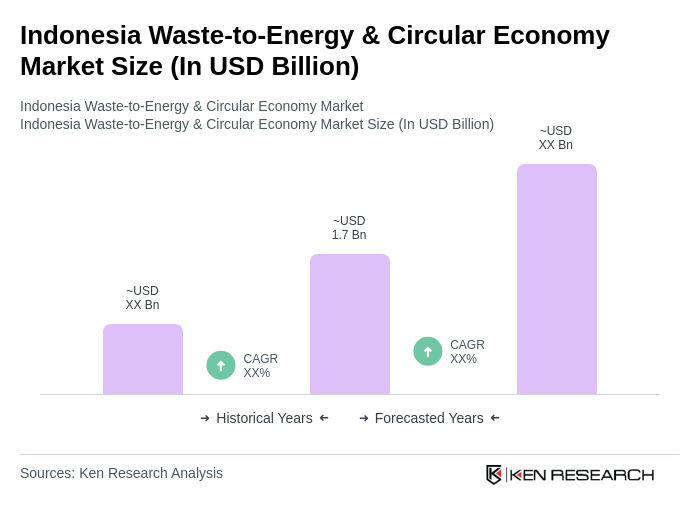
- The Indonesia Waste-to-Energy & Circular Economy Market is valued at USD 1.7 billion, based on a five-year historical analysis. This growth is primarily driven by rapid urbanization, government initiatives to increase renewable energy’s share in the national energy mix, and a surge in environmental sustainability awareness among consumers. Additional drivers include significant investments in waste management infrastructure and advanced technologies, which are essential for converting waste into energy and other valuable resources. The government’s focus on expanding waste-to-energy facilities and integrating modern treatment methods further accelerates market expansion.
- Key cities such as Jakarta, Surabaya, and Bandung dominate the market due to their high population density and substantial waste generation. Jakarta, as the capital, has implemented large-scale waste management programs and public-private partnerships to advance waste-to-energy projects. Surabaya and Bandung are also recognized for their progressive adoption of sustainable waste management practices, positioning them as pivotal players in Indonesia’s circular economy landscape.
- The regulatory framework is anchored by the Waste Management Law No. 18/2008, issued by the Ministry of Environment and Forestry, which mandates local governments to implement integrated waste management systems prioritizing waste reduction, recycling, and energy recovery. This law, complemented by Presidential Regulation No. 35 of 2018, requires compliance with environmental standards and encourages investments in waste-to-energy technologies, thereby supporting the circular economy’s growth in Indonesia.
Indonesia Waste-to-Energy & Circular Economy Market Segmentation
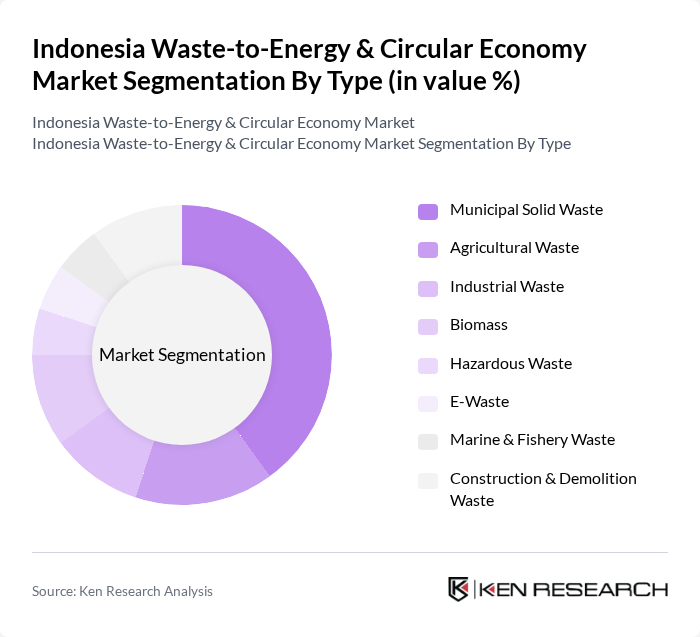
By Type:The market is segmented by waste type, each contributing uniquely to the waste-to-energy and circular economy landscape. The subsegments include Municipal Solid Waste, Agricultural Waste, Industrial Waste, Biomass, Hazardous Waste, E-Waste, Marine & Fishery Waste, and Construction & Demolition Waste. Municipal Solid Waste remains the most significant contributor due to its volume and high potential for energy conversion. Agricultural and industrial waste streams also play a vital role, especially in regions with strong agribusiness and manufacturing sectors. Biomass and hazardous waste are increasingly processed using advanced thermal and biological technologies, while e-waste, marine, and construction waste are gaining attention for their resource recovery potential.
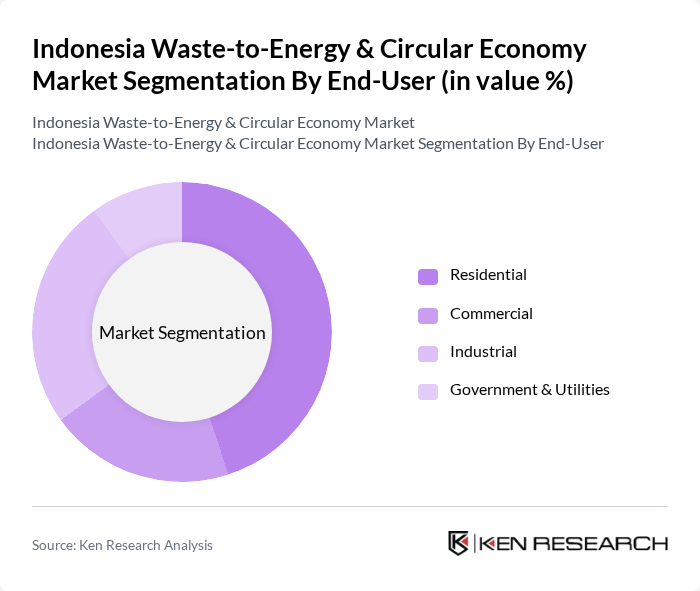
By End-User:The end-user segmentation includes Residential, Commercial, Industrial, and Government & Utilities. The Residential segment is the largest due to the high volume of household waste generated in urban centers. The Industrial segment is notable for its diverse waste streams and energy recovery initiatives, while Commercial and Government & Utilities segments are increasingly adopting sustainable waste management solutions to meet regulatory and environmental standards.
Indonesia Waste-to-Energy & Circular Economy Market Competitive Landscape
The Indonesia Waste-to-Energy & Circular Economy Market is characterized by a dynamic mix of regional and international players. Leading participants such as PT PLN (Persero), PT Waste4Change, PT Bioenergi Nusantara, PT Indah Kiat Pulp & Paper Tbk, PT Pupuk Indonesia (Persero), PT Sumberdaya Sewatama, PT Energi Hijau Lestari, PT Cipta Kridatama, PT Veolia Services Indonesia, PT Solusi Bangun Indonesia Tbk, PT Wira Sukses Lestari, PT Surya Energi Indotama, PT Green Energy Indonesia, PT Mitra Energi Nusantara, PT Energi Terbarukan Indonesia, PT MITSUBISHI HEAVY INDUSTRIES INDONESIA, PT Jakarta Propertindo (Jakpro), PT Reciki Solusi Indonesia, PT Chandra Asri Pacific Tbk, PT Unilever Indonesia Tbk (Waste Management Division) contribute to innovation, geographic expansion, and service delivery in this space.
Indonesia Waste-to-Energy & Circular Economy Market Industry Analysis
Growth Drivers
- Increasing Urbanization:Indonesia's urban population is projected to reach 68% in future, up from approximately 57% in recent years, according to the World Bank. This rapid urbanization leads to increased waste generation, estimated at approximately 67.8 million tons annually. Urban areas are struggling to manage this waste effectively, creating a pressing need for waste-to-energy solutions. The growing urban population also drives demand for sustainable energy sources, further propelling the waste-to-energy market.
- Government Initiatives for Renewable Energy:The Indonesian government aims to achieve a renewable energy mix of 23% in future, as outlined in the National Energy Policy. This includes significant investments in waste-to-energy projects, with a target of generating 2,000 MW from waste in future. The government has allocated approximately $1.5 billion for renewable energy initiatives, fostering an environment conducive to the growth of the waste-to-energy sector.
- Rising Waste Generation:Indonesia generates approximately 175,000 tons of waste daily, with projections indicating a rise to 210,000 tons in future. This increase is driven by population growth and changing consumption patterns. The escalating waste crisis necessitates innovative solutions, such as waste-to-energy technologies, to manage waste sustainably. The urgency to address waste management challenges presents a significant growth opportunity for the waste-to-energy market.
Market Challenges
- High Initial Investment Costs:The capital required for establishing waste-to-energy facilities in Indonesia can exceed $300 million per project. This high initial investment poses a significant barrier to entry for many potential investors. Additionally, the long payback period, often exceeding 10 years, discourages investment in this sector. Financial constraints limit the development of necessary infrastructure, hindering market growth.
- Regulatory Compliance Issues:Navigating Indonesia's complex regulatory landscape can be challenging for waste-to-energy projects. The country has over 20 regulations governing waste management and energy production, which can lead to delays and increased costs. Compliance with environmental standards, such as the Environmental Protection Law, requires significant resources and expertise, creating hurdles for project developers and impacting overall market growth.
Indonesia Waste-to-Energy & Circular Economy Market Future Outlook
The future of Indonesia's waste-to-energy and circular economy market appears promising, driven by increasing urbanization and government support for renewable energy initiatives. As waste generation continues to rise, innovative waste management solutions will become essential. The integration of advanced technologies and public-private partnerships will likely enhance project viability. Furthermore, growing public awareness of sustainability will encourage community involvement, fostering a more robust circular economy and driving investment in waste-to-energy projects.
Market Opportunities
- Expansion of Public-Private Partnerships:Collaborations between the government and private sector can facilitate the development of waste-to-energy projects. By leveraging private investment and expertise, Indonesia can enhance its waste management infrastructure, potentially increasing project efficiency and reducing costs. This partnership model can attract more stakeholders, driving growth in the waste-to-energy sector.
- Development of Advanced Waste Processing Technologies:Investing in innovative waste processing technologies can significantly improve the efficiency of waste-to-energy conversion. Technologies such as anaerobic digestion and gasification can enhance energy recovery rates. By adopting these advanced methods, Indonesia can optimize waste management practices, reduce environmental impact, and create a more sustainable energy landscape.
Scope of the Report
| Segment | Sub-Segments |
|---|---|
| By Type | Municipal Solid Waste Agricultural Waste Industrial Waste Biomass Hazardous Waste E-Waste Marine & Fishery Waste Construction & Demolition Waste |
| By End-User | Residential Commercial Industrial Government & Utilities |
| By Application | Energy Generation (Electricity, Heat, Biogas) Waste Management (Landfill Diversion, Volume Reduction) Material Recovery (Recycling, Composting, RDF) Environmental Remediation |
| By Investment Source | Domestic Investment Foreign Direct Investment (FDI) Public-Private Partnerships (PPP) Government Schemes |
| By Policy Support | Subsidies Tax Exemptions Renewable Energy Certificates (RECs) |
| By Technology | Anaerobic Digestion Incineration Gasification Pyrolysis Refuse-Derived Fuel (RDF) Mechanical-Biological Treatment (MBT) |
| By Distribution Mode | Direct Sales Online Sales Distributors Others |
Key Target Audience
Investors and Venture Capitalist Firms
Government and Regulatory Bodies (e.g., Ministry of Environment and Forestry, Ministry of Energy and Mineral Resources)
Waste Management Companies
Energy Producers and Utilities
Environmental NGOs and Advocacy Groups
Technology Providers and Equipment Manufacturers
Local Government Authorities
Financial Institutions and Banks
Players Mentioned in the Report:
PT PLN (Persero)
PT Waste4Change
PT Bioenergi Nusantara
PT Indah Kiat Pulp & Paper Tbk
PT Pupuk Indonesia (Persero)
PT Sumberdaya Sewatama
PT Energi Hijau Lestari
PT Cipta Kridatama
PT Veolia Services Indonesia
PT Solusi Bangun Indonesia Tbk
PT Wira Sukses Lestari
PT Surya Energi Indotama
PT Green Energy Indonesia
PT Mitra Energi Nusantara
PT Energi Terbarukan Indonesia
PT MITSUBISHI HEAVY INDUSTRIES INDONESIA
PT Jakarta Propertindo (Jakpro)
PT Reciki Solusi Indonesia
PT Chandra Asri Pacific Tbk
PT Unilever Indonesia Tbk (Waste Management Division)
Table of Contents
Market Assessment Phase
1. Executive Summary and Approach
2. Indonesia Waste-to-Energy & Circular Economy Market Overview
2.1 Key Insights and Strategic Recommendations
2.2 Indonesia Waste-to-Energy & Circular Economy Market Overview
2.3 Definition and Scope
2.4 Evolution of Market Ecosystem
2.5 Timeline of Key Regulatory Milestones
2.6 Value Chain & Stakeholder Mapping
2.7 Business Cycle Analysis
2.8 Policy & Incentive Landscape
3. Indonesia Waste-to-Energy & Circular Economy Market Analysis
3.1 Growth Drivers
3.1.1 Increasing Urbanization
3.1.2 Government Initiatives for Renewable Energy
3.1.3 Rising Waste Generation
3.1.4 Public Awareness of Sustainability
3.2 Market Challenges
3.2.1 High Initial Investment Costs
3.2.2 Regulatory Compliance Issues
3.2.3 Technological Limitations
3.2.4 Public Resistance to Waste-to-Energy Projects
3.3 Market Opportunities
3.3.1 Expansion of Public-Private Partnerships
3.3.2 Development of Advanced Waste Processing Technologies
3.3.3 International Collaboration for Knowledge Sharing
3.3.4 Investment in Infrastructure Development
3.4 Market Trends
3.4.1 Shift Towards Circular Economy Models
3.4.2 Integration of Smart Technologies
3.4.3 Increased Focus on Environmental Regulations
3.4.4 Growth of Community-Based Waste Management Initiatives
3.5 Government Regulation
3.5.1 National Waste Management Policy
3.5.2 Renewable Energy Law
3.5.3 Environmental Protection Regulations
3.5.4 Incentives for Renewable Energy Projects
4. SWOT Analysis
5. Stakeholder Analysis
6. Porter's Five Forces Analysis
7. Indonesia Waste-to-Energy & Circular Economy Market Market Size, 2019-2024
7.1 By Value
7.2 By Volume
7.3 By Average Selling Price
8. Indonesia Waste-to-Energy & Circular Economy Market Segmentation
8.1 By Type
8.1.1 Municipal Solid Waste
8.1.2 Agricultural Waste
8.1.3 Industrial Waste
8.1.4 Biomass
8.1.5 Hazardous Waste
8.1.6 E-Waste
8.1.7 Marine & Fishery Waste
8.1.8 Construction & Demolition Waste
8.2 By End-User
8.2.1 Residential
8.2.2 Commercial
8.2.3 Industrial
8.2.4 Government & Utilities
8.3 By Application
8.3.1 Energy Generation (Electricity, Heat, Biogas)
8.3.2 Waste Management (Landfill Diversion, Volume Reduction)
8.3.3 Material Recovery (Recycling, Composting, RDF)
8.3.4 Environmental Remediation
8.4 By Investment Source
8.4.1 Domestic Investment
8.4.2 Foreign Direct Investment (FDI)
8.4.3 Public-Private Partnerships (PPP)
8.4.4 Government Schemes
8.5 By Policy Support
8.5.1 Subsidies
8.5.2 Tax Exemptions
8.5.3 Renewable Energy Certificates (RECs)
8.6 By Technology
8.6.1 Anaerobic Digestion
8.6.2 Incineration
8.6.3 Gasification
8.6.4 Pyrolysis
8.6.5 Refuse-Derived Fuel (RDF)
8.6.6 Mechanical-Biological Treatment (MBT)
8.7 By Distribution Mode
8.7.1 Direct Sales
8.7.2 Online Sales
8.7.3 Distributors
8.7.4 Others
9. Indonesia Waste-to-Energy & Circular Economy Market Competitive Analysis
9.1 Market Share of Key Players
9.2 Cross Comparison of Key Players
9.2.1 Company Name
9.2.2 Group Size (Large, Medium, or Small as per industry convention)
9.2.3 Revenue Growth Rate (3-year CAGR)
9.2.4 Market Penetration Rate (Share of Installed WtE Capacity or Projects)
9.2.5 Project Pipeline (Number and Capacity of Ongoing/Upcoming Projects)
9.2.6 Feedstock Diversification (Types of Waste Processed)
9.2.7 Operational Efficiency (Plant Load Factor, Uptime %)
9.2.8 Technology Adoption Level (Advanced/Conventional)
9.2.9 Environmental Compliance (Emission Standards, Certifications)
9.2.10 Sustainability Index (GHG Reduction, Circularity Score)
9.2.11 Innovation Rate (Patents, New Process Adoption)
9.2.12 Local Content Utilization (%)
9.3 SWOT Analysis of Top Players
9.4 Pricing Analysis
9.5 Detailed Profile of Major Companies
9.5.1 PT PLN (Persero)
9.5.2 PT Waste4Change
9.5.3 PT Bioenergi Nusantara
9.5.4 PT Indah Kiat Pulp & Paper Tbk
9.5.5 PT Pupuk Indonesia (Persero)
9.5.6 PT Sumberdaya Sewatama
9.5.7 PT Energi Hijau Lestari
9.5.8 PT Cipta Kridatama
9.5.9 PT Veolia Services Indonesia
9.5.10 PT Solusi Bangun Indonesia Tbk
9.5.11 PT Wira Sukses Lestari
9.5.12 PT Surya Energi Indotama
9.5.13 PT Green Energy Indonesia
9.5.14 PT Mitra Energi Nusantara
9.5.15 PT Energi Terbarukan Indonesia
9.5.16 PT MITSUBISHI HEAVY INDUSTRIES INDONESIA
9.5.17 PT Jakarta Propertindo (Jakpro)
9.5.18 PT Reciki Solusi Indonesia
9.5.19 PT Chandra Asri Pacific Tbk
9.5.20 PT Unilever Indonesia Tbk (Waste Management Division)
10. Indonesia Waste-to-Energy & Circular Economy Market End-User Analysis
10.1 Procurement Behavior of Key Ministries
10.1.1 Ministry of Environment and Forestry
10.1.2 Ministry of Energy and Mineral Resources
10.1.3 Ministry of Public Works and Housing
10.2 Corporate Spend on Infrastructure & Energy
10.2.1 Investment in Renewable Energy Projects
10.2.2 Budget Allocation for Waste Management
10.2.3 Expenditure on Sustainable Practices
10.3 Pain Point Analysis by End-User Category
10.3.1 Residential Concerns
10.3.2 Commercial Waste Management Issues
10.3.3 Industrial Compliance Challenges
10.4 User Readiness for Adoption
10.4.1 Awareness of Waste-to-Energy Benefits
10.4.2 Financial Readiness for Investment
10.4.3 Technical Capability Assessment
10.5 Post-Deployment ROI and Use Case Expansion
10.5.1 Measurement of Energy Savings
10.5.2 Assessment of Environmental Impact
10.5.3 Opportunities for Scaling Solutions
11. Indonesia Waste-to-Energy & Circular Economy Market Future Size, 2025-2030
11.1 By Value
11.2 By Volume
11.3 By Average Selling Price
Go-To-Market Strategy Phase
1. Whitespace Analysis + Business Model Canvas
1.1 Market Gaps Identification
1.2 Value Proposition Development
1.3 Revenue Streams Analysis
1.4 Key Partnerships Exploration
1.5 Cost Structure Evaluation
1.6 Customer Segmentation
1.7 Channels of Distribution
2. Marketing and Positioning Recommendations
2.1 Branding Strategies
2.2 Product USPs
2.3 Target Market Identification
2.4 Communication Strategy
2.5 Digital Marketing Approaches
2.6 Community Engagement Plans
3. Distribution Plan
3.1 Urban Retail Strategies
3.2 Rural NGO Tie-ups
3.3 Logistics and Supply Chain Management
3.4 Distribution Channel Optimization
3.5 Partnership with Local Distributors
4. Channel & Pricing Gaps
4.1 Underserved Routes
4.2 Pricing Bands Analysis
4.3 Competitor Pricing Strategies
4.4 Customer Willingness to Pay
4.5 Price Sensitivity Assessment
5. Unmet Demand & Latent Needs
5.1 Category Gaps Identification
5.2 Consumer Segments Analysis
5.3 Emerging Trends in Consumer Preferences
5.4 Future Demand Projections
6. Customer Relationship
6.1 Loyalty Programs
6.2 After-sales Service
6.3 Customer Feedback Mechanisms
6.4 Engagement Strategies
6.5 Retention Strategies
7. Value Proposition
7.1 Sustainability Initiatives
7.2 Integrated Supply Chains
7.3 Competitive Advantages
7.4 Customer-Centric Innovations
7.5 Long-term Value Creation
8. Key Activities
8.1 Regulatory Compliance
8.2 Branding Initiatives
8.3 Distribution Setup
8.4 Training and Development
8.5 Performance Monitoring
9. Entry Strategy Evaluation
9.1 Domestic Market Entry Strategy
9.1.1 Product Mix
9.1.2 Pricing Band
9.1.3 Packaging Considerations
9.2 Export Entry Strategy
9.2.1 Target Countries
9.2.2 Compliance Roadmap
9.2.3 Market Entry Barriers
9.2.4 Export Regulations
10. Entry Mode Assessment
10.1 Joint Ventures
10.2 Greenfield Investments
10.3 Mergers & Acquisitions
10.4 Distributor Model
11. Capital and Timeline Estimation
11.1 Capital Requirements
11.2 Timelines for Implementation
11.3 Financial Projections
12. Control vs Risk Trade-Off
12.1 Ownership vs Partnerships
12.2 Risk Mitigation Strategies
12.3 Control Mechanisms
13. Profitability Outlook
13.1 Breakeven Analysis
13.2 Long-term Sustainability
13.3 Profit Margin Projections
14. Potential Partner List
14.1 Distributors
14.2 Joint Ventures
14.3 Acquisition Targets
15. Execution Roadmap
15.1 Phased Plan for Market Entry
15.1.1 Market Setup
15.1.2 Market Entry
15.1.3 Growth Acceleration
15.1.4 Scale & Stabilize
15.2 Key Activities and Milestones
15.2.1 Milestone Identification
15.2.2 Activity Scheduling
15.2.3 Resource Allocation
Research Methodology
Phase 1: Approach1
Desk Research
- Analysis of government reports on waste management policies and regulations in Indonesia
- Review of industry publications and market reports on waste-to-energy technologies and circular economy practices
- Examination of academic journals and case studies focusing on successful waste-to-energy projects in Southeast Asia
Primary Research
- Interviews with key stakeholders in the waste management sector, including municipal authorities and waste management companies
- Surveys with industry experts and consultants specializing in renewable energy and circular economy initiatives
- Field visits to operational waste-to-energy plants to gather firsthand insights on processes and challenges
Validation & Triangulation
- Cross-validation of findings through comparison with international best practices in waste-to-energy systems
- Triangulation of data from government sources, industry reports, and expert interviews to ensure consistency
- Sanity checks through feedback from a panel of experts in environmental science and energy policy
Phase 2: Market Size Estimation1
Top-down Assessment
- Estimation of total waste generation in Indonesia and potential waste-to-energy conversion rates
- Analysis of government funding and incentives for waste-to-energy projects and circular economy initiatives
- Segmentation of the market by waste type (organic, plastic, etc.) and energy output potential
Bottom-up Modeling
- Collection of operational data from existing waste-to-energy facilities to establish performance benchmarks
- Cost analysis of technology implementation, including capital and operational expenditures
- Volume and energy output projections based on waste input and conversion efficiency rates
Forecasting & Scenario Analysis
- Development of predictive models incorporating economic growth, urbanization rates, and waste generation trends
- Scenario planning based on varying levels of regulatory support and public acceptance of waste-to-energy solutions
- Creation of multiple forecasts (baseline, optimistic, and pessimistic) to assess market potential through 2030
Phase 3: CATI Sample Composition1
| Scope Item/Segment | Sample Size | Target Respondent Profiles |
|---|---|---|
| Municipal Waste Management Authorities | 60 | City Managers, Waste Management Directors |
| Waste-to-Energy Facility Operators | 50 | Plant Managers, Operations Supervisors |
| Environmental NGOs and Advocacy Groups | 40 | Policy Analysts, Program Directors |
| Private Sector Waste Management Companies | 50 | Business Development Managers, Technical Directors |
| Government Regulatory Bodies | 40 | Regulatory Affairs Specialists, Environmental Officers |
Frequently Asked Questions
What is the current value of the Indonesia Waste-to-Energy & Circular Economy Market?
The Indonesia Waste-to-Energy & Circular Economy Market is valued at approximately USD 1.7 billion, driven by urbanization, government initiatives for renewable energy, and increased consumer awareness of environmental sustainability.
What are the main drivers of growth in the Indonesia Waste-to-Energy market?
Which cities are leading in the Indonesia Waste-to-Energy market?
What types of waste are processed in Indonesia's Waste-to-Energy facilities?
Other Regional/Country Reports
Indonesia Waste-to-Energy & Circular Economy Market
Malaysia Waste-to-Energy & Circular Economy Market
KSA Waste-to-Energy & Circular Economy Market
APAC Waste-to-Energy & Circular Economy Market
SEA Waste-to-Energy & Circular Economy Market
Vietnam Waste-to-Energy & Circular Economy Market
Why Buy From Us?

What makes us stand out is that our consultants follow Robust, Refine and Result (RRR) methodology. Robust for clear definitions, approaches and sanity checking, Refine for differentiating respondents' facts and opinions, and Result for presenting data with story.

We have set a benchmark in the industry by offering our clients with syndicated and customized market research reports featuring coverage of entire market as well as meticulous research and analyst insights.

While we don't replace traditional research, we flip the method upside down. Our dual approach of Top Bottom & Bottom Top ensures quality deliverable by not just verifying company fundamentals but also looking at the sector and macroeconomic factors.

With one step in the future, our research team constantly tries to show you the bigger picture. We help with some of the tough questions you may encounter along the way: How is the industry positioned? Best marketing channel? KPI's of competitors? By aligning every element, we help maximize success.

Our report gives you instant access to the answers and sources that other companies might choose to hide. We elaborate each steps of research methodology we have used and showcase you the sample size to earn your trust.

If you need any support, we are here! We pride ourselves on universe strength, data quality, and quick, friendly, and professional service.